


Each week on The Newsfeed, host Paris Jackson and a team of veteran journalists dive deep into one topic and provide impactful reporting, interviews and community insights from sources you can trust. Each day this week, this post will be updated with a new story from the team.
Chinook salmon already benefitting from tribal restoration project
By Paris Jackson
More than a decade ago, the Stillaguamish Tribe began a journey to help save the federally protected Chinook salmon, a species of historical and cultural significance to them.
The tribe bought back farmland to transform into wetlands that the fish haven't swam in for more than a century. Stillaguamish Tribal member and Deputy Fisheries Manager Scott Boyd is pleased with the progress.
“It's amazing... it took decades to get to this point where we can acquire sufficient land base to implement these types of projects and to see in the first spring since it's been opened to already see those, successful markers. It's really encouraging for the tribes, so we’re thrilled,” Boyd said.
The tribe’s environmental program manager Jason Griffith says the overall project spans about 850 acres, split into three phases.
In 2017, construction of the first phase called “Zis a ba I” started – it's named after a Stillaguamish chief. It transformed more than 90 acres into a marsh.
Last summer, an even larger “Zis a ba II” took over more than 200 acres of land restoring restoring the habitat for fish and wildlife.
“Chinook salmon, when they're coming out, from the river to the sea, they spend several months down here in these marshes gaining size before they head offshore. And if they don't get big enough, they can get eaten by larger predators. And so these marshes serve as a spot, a stopover to gain the size they need to survive in the ocean,” Griffith explained. “And the three stages of the project that we're working on, and we're standing here at the just above phase two, which is 230 acres that we restored last summer in 2025.”
Griffith says flooding is a natural part of the function of a river.
“Those natural processes like flooding, create and sustain salmon habitat over time. And so by allowing flood energy to spread out across the landscape, it's often less harmful than if you’re concentrating it right in the river channel. And so part of this project is allowing that energy to spread out and create salmon habitat over a larger footprint in a less harmful way to what would be if you channelized and concentrated that flood energy,” Griffith said.
The tribe is already starting to see some benefits from the project.
“We started noticing waterfowl and shorebirds in areas, that we didn't see them before the project. And then as the months went on and the Chinook salmon started coming out of the gravel and working their way down the river, we started to see them inside the site. And these are marshes, that had been cut off for 140 years,” he said.
The restoration project also involves dealing with contamination on the land.
“For properties like this that have been farmed for well over 100 years, you expect to find some level of contamination. It’s not just the goal of the Stillaguamish Tribe to restore these lands to their ecological function, but it's also to ensure that the water and the land is free of toxics. That way, future generations of salmon that visit these waters can survive healthily” Stillaguamish Tribe of Indians Response Program Co-manager, Rainer Luhrs said.
Boyd has his eyes set on what the Chinook’s recovery could mean for generations to come.
“Hopefully, continue to see those positive signs and pay it forward to the future generations. Because, yeah, I have four young children and I would love to see them be able to fish out here and have a healthy environment,” Boyd said.
New book links Tacoma's toxic legacy to Pacific NW serial killers
By Lizz Giordano, story published 04/17/2026
For nearly a century, a copper smelter in north Tacoma pumped the air with lead, arsenic and other heavy metals. The pollution settled into the soil over an area that stretches 1,000 miles along the Puget Sound basin.
A new book makes the argument that this industrial pollution - particularly lead from the Tacoma smelter - and exhaust from leaded gasoline may help explain why the Pacific Northwest became a hotbed for serial killers in the ‘70s and ‘80s. In Murderland: Crime and Bloodlust in the Time of Serial Killers, author Caroline Fraser traces that toxic legacy to killers like Ted Bundy and the Green River Killer Gary Ridgway.
Dr. Bruce Lanphear, an epidemiologist and professor at Simon Fraser University, says the author’s hypothesis doesn’t seem outlandish to him. He says scientists can’t prove an association between lead and serial killers because it’s such a rare event. But there are many studies that show a link between violence and lead.
“We have study after study after study showing that lead exposure increases the rate of conduct disorder in children that's acting out behavior, bullying, pulling hair, starting fires in children, and the evidence is very consistent. We have evidence that it diminishes IQ and increases ADHD, and those are correlated with criminal behavior,” Lanphear said.
Of course, the vast majority of people who grew up in the shadow of the pollution plume never became serial killers.
“It could be that some of these serial killers actually had higher exposure than other people on average. It could be that the duration of exposure was longer,” Lanphear said. “Or it could be that they had more than just lead exposure…. maybe plus arsenic exposure, perhaps maltreated as a child, that those collectively, that those add up.”
Will Skiing in Washington Exist in 20 Years?
By Jaelynn Grisso, story published 04/15/2026
An unseasonably warm winter has meant much less snowfall than normal, impacting our regional snowpack and leading to questions about the future of snow sports.
“Whenever you have a low snowfall year, it just means conditions aren't quite as good,” said Karter Riach, VP of Marketing and Sales at The Summit at Snoqualmie. “Skiers and riders adapt and figure out, you know, ‘I’m going to go have fun and ski and snowboard regardless.’ But there's a certain amount of visitation that's just lost entirely because you don't have the snow depth or the conditions that a lot of skiers and riders wanted.”
But it’s not just skiers and snowboarders feeling the sting from a lack of snow. The reduced snowpack also means less water in the spring and summer, which creates drought conditions.
“It's really important because in Washington state we have a distinct wet season and a dry season,” said Karin Bumbaco, Deputy State Climatologist at the Washington State Climate Office through the University of Washington. “We like to save water during the wet season to use it when we don't see a lot of precipitation in the spring and summer in Washington. And so our snowpack does that for us. It actually stores a fair amount of water that even our reservoirs can't hold.”
Last week, the Washington Department of Ecology declared a statewide emergency drought. That makes this the fourth year in a row all or part of the state has been under a drought declaration.
Bumbaco said the trend toward warmer weather and precipitation falling as rain rather than snow is exactly what she expects to see with climate change. But that doesn't mean the demise of snow sports.
“Winter recreation isn't going away completely in Washington,” Bumbaco said. “We know that our snowpack will be reduced. But even by the 2050 is we will still see years where there's still enough snowpack to recreate in our mountains.”
From out of the blue bins, Seattle's recycling gets a gallery show
By Brangien Davis, story published 04/14/2026
For Seattleites, tossing recyclable items into a blue bin is second nature. But exactly where those discarded paper products and plastic bottles end up is often “outta sight, outta mind.”
So here’s a surprise: Some of the castoffs that land at the Recology Material Recovery Facility in Sodo might end up on the walls of an art gallery.
That’s thanks to Recology King County’s Artist-in-Residence program, which for over a decade has invited two artists per year inside the conveyor-belt-filled facility and given them “scavenging privileges” to pick up whatever discarded items catch their creative eye.
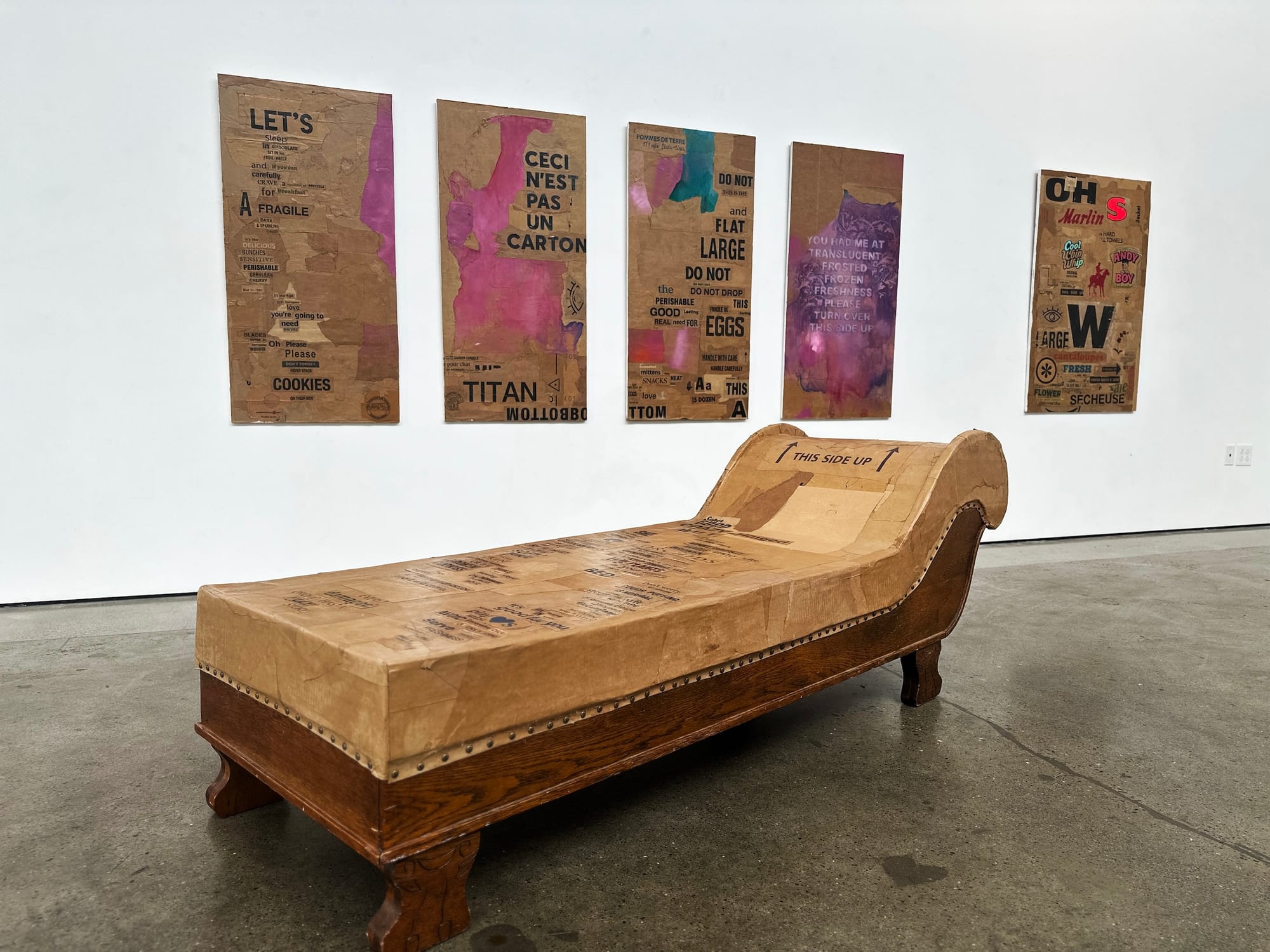
The goal is to combine waste reduction with art creation.
We visited the Willa-Wonka-like facility to talk with Artist-in-Residence co-managers Maria Phillips and Amanda Manitach — both former artists in residence themselves — and learn more about this ongoing environmental art program.
In past years, selected painters, sculptors and textile artists have transformed trash into beautiful, intriguing and sometimes humorous artworks — whether made from shampoo bottles, paper cups, wire shelving or plastic bags.
Manitach says artists first coming into the facility are often overwhelmed by the possibilities. “They have a thousand ideas,” she says, about “how they want to engage with the machine and how they want to engage with that material coming in.”
During each four-month residency, artists collect materials from the giant green sorting machine and create art in an on-site studio. In the process, they expand their understanding of what might be considered art materials — and several have said they never want to buy art supplies again.
“A lot of people come in as painters, sculptors, photographers… and have their eyes opened and leave the experience thinking very differently about their own work,” says Phillips. Her own residency prompted her to use only recycled materials in all her artmaking going forward.
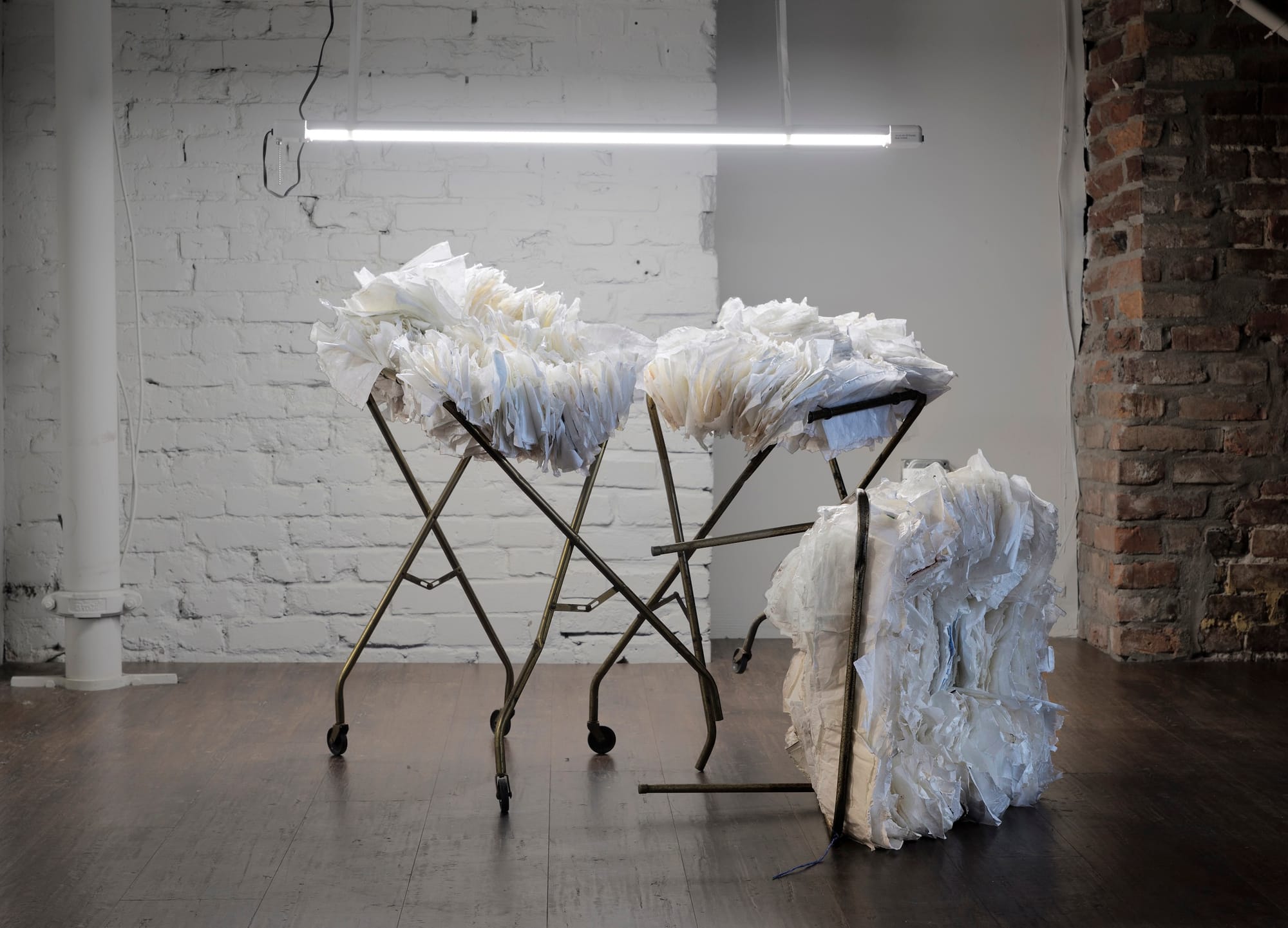
Through annual exhibits of this trash-turned-art, Recology is spreading the knowledge that recycling means much more than just the blue bins — it’s about changing the social mindset toward increasing sustainability and resource recovery.
After being sorted, cleaned and smashed into bales based on material type — such as aluminum cans, tin cans, clear plastics, metal and cardboard — one-ton bricks are sold to businesses that reprocess and reuse the discarded materials, putting them back to work as recycled products.
Participating artists are doing something similar, but in their case, the output might be a flag woven from plastic bags or a wall hanging made from colorful sneaker soles.
This year’s artists-in-residence are Eirik Johnson, a photographer and sound artist, and Janelle Abbott, a sustainable-fashion designer. You can check out their completed artworks in an exhibit opening September 4-12, at Mutuus Studio in Georgetown (opening reception Sept. 4, closing reception Sept 12).
The impact on the artists, however, lasts longer than any exhibit. “You can’t leave this residency — or even this building — without having been transformed,” Manitach says.
The Climate Commitment Act Five Years Later
By Venice Buhain, story published 04/13/2026
This week, ahead of Earth Day, we’re focusing on stories about the environment, starting with a look at how Washington’s Climate Commitment Act is playing out 5 years after it was created
The law aims to reduce greenhouse gas emissions by allowing companies to buy into a cap-and-invest auction system.
How does it work?
The state sets prices on what’s called a pollution or carbon allowance. Places like paper mills or petroleum refineries bid on a limited number of allowances, or they can change their operations to reduce their fossil fuel consumption.
So how much money has it raised?
More than $4 billion since it started collecting revenue in 2023. The money is directed to projects that reduce the use of fossil fuels or lessen the effects of pollution on the most affected communities. Projects throughout the state have included rural charging stations, salmon restoration projects, insulating homes for energy efficiency and electric bike programs. The state has created a dashboard showing how the money is spent.
Did we vote on the Climate Commitment Act?
Yes, we did - eventually. The law survived a challenge in 2024, when a group called Let’s Go Washington put an initiative on the ballot that would have repealed the Climate Commitment Act. Voters struck it down and kept the law as-is.
Does it raise gas prices?
Yes, but it isn’t the only factor raising gas prices in Washington state. Critics have said the law has indirectly raised gas prices by as much as 50 cents a gallon. But on top of that, Washington already has the third-highest gas taxes and fees in the nation at 59 cents per gallon. And of course, global and market conditions are also a factor in rising gas prices.
Didn’t lawmakers redirect that money to address a state budget gap?
Not this year. Governor Bob Ferguson and both the House and Senate floated the idea of redirecting Climate Commitment Act revenue to help close the state’s $2.3 billion budget gap. But, in the end, the Climate Commitment Act revenue remained directed toward environmental projects and programs.


