


On January 28,1700 large tsunami waves slashed a 500-mile stretch of the Island of Honshu, Japan. No earthquake was felt, but accounts of damage to villages by huge waves and, in one case, the wreck of ship were preserved in Japan’s written records. These suggested that somewhere in the Pacific a massive quake had occurred.
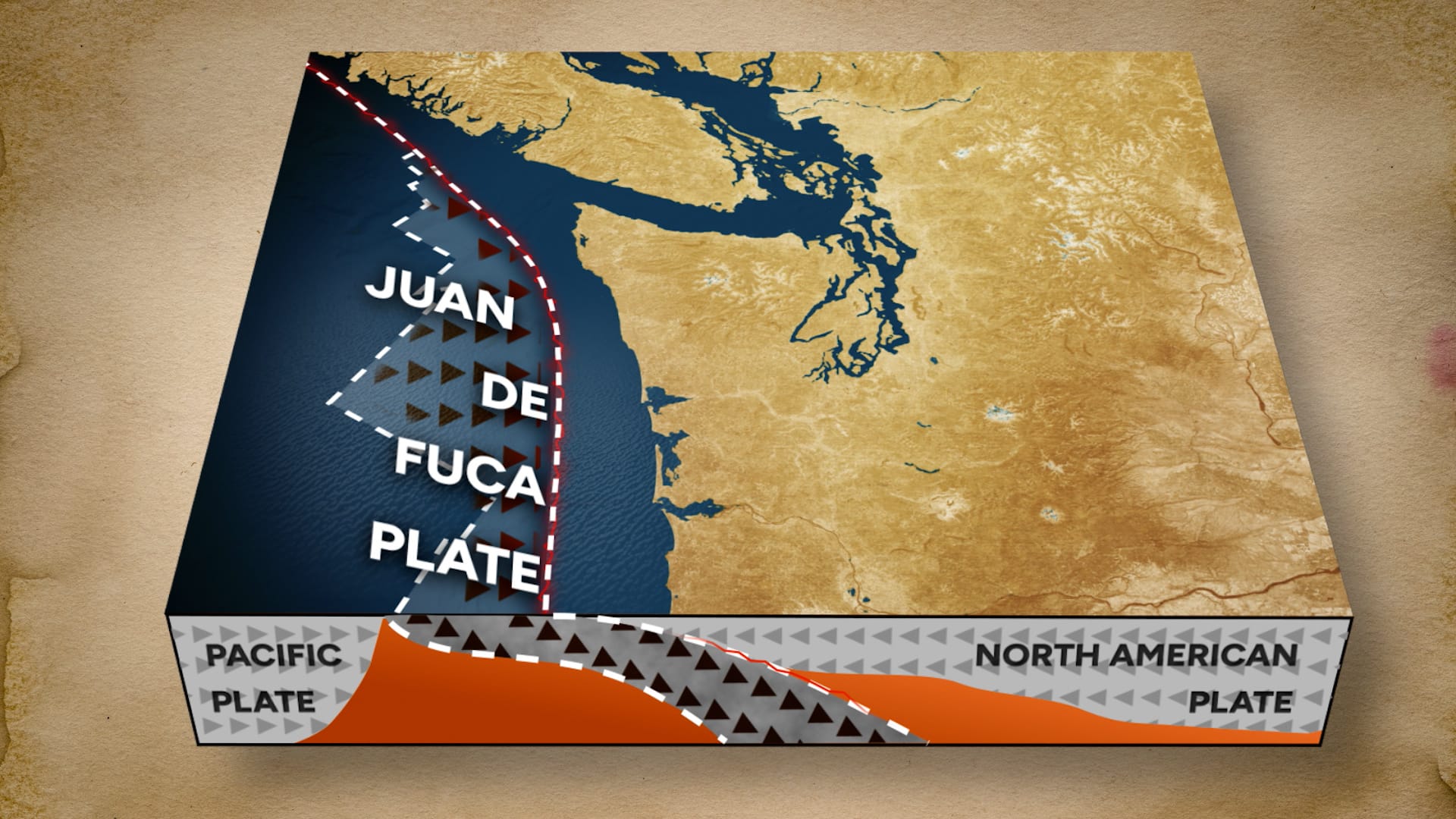
And it had, off the Northwest coast of North America two days earlier when the Juan de Fuca plate subduction zone ruptured and a massive 8.7 to 9.2 quake shook the region and altered the coastline from northern California to Vancouver Island with waves, flooding and landslides that drowned forests and destroyed Indigenous villages.
This is the “Big One” that experts are expecting to recur. Evidence suggests major Juan de Fuca quakes can happen at 300- to 900-year intervals. If you travel to the coast you’ll likely see signs indicating evacuation routes if a tsunami is on the way. Enjoy your stay!
There’s no doubt that another Big One would be devastating to the region, but on Puget Sound we’re a bit sheltered from a Juan de Fuca plate lollapalooza: the inner Salish Sea isn’t generally on the front lines of impact, and the Olympic mountains stand between Seattle and the Pacific coast. But we don’t need to look far for evidence of earthshaking changes here. We have faults of our own.
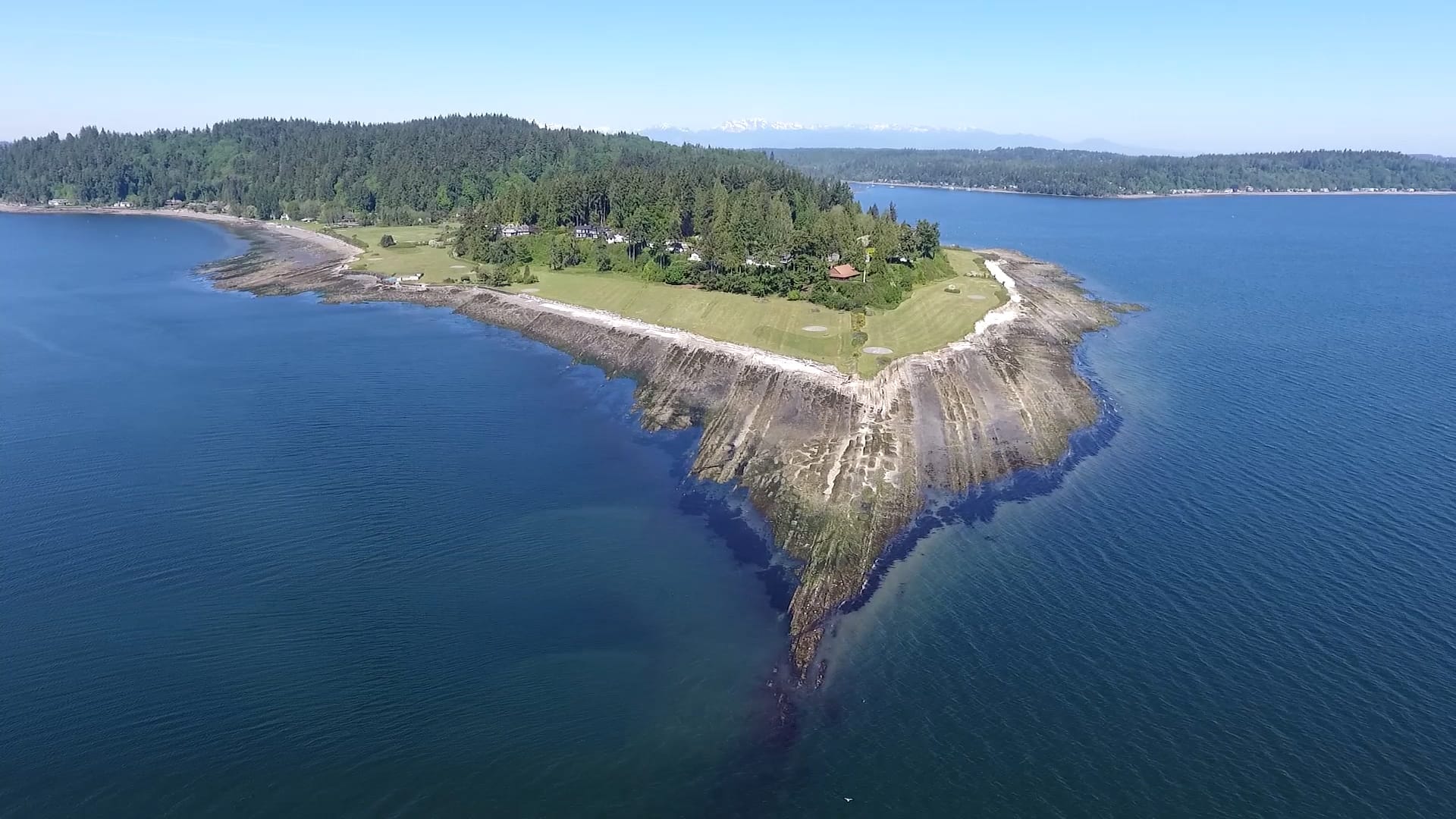
Notably, after much of Seattle was built, we found ourselves sitting on a previously unknown earthquake fault, the so-called Seattle Fault, that runs roughly from Hood Canal through south Seattle to Issaquah. Scientists only confirmed its existence in 1992.
The evidence of it included a still standing sunken forest in Lake Washington that slid off Mercer Island, and land on Bainbridge Island and West Seattle that had been lifted up between 20 and 30 feet. It generated a localized tsunami too. Testing revealed the quake that did that happened about 1,000 years ago. It changed the local landscape dramatically.
Those of us who live in and around Puget Sound know that the earth can shake periodically and create those moments of “where were you when the quake hit?” Like the 1949 quake, or the 1965 quake, or the 2001 Nisqually? By comparison to the Big One, these have been gentle reminders.
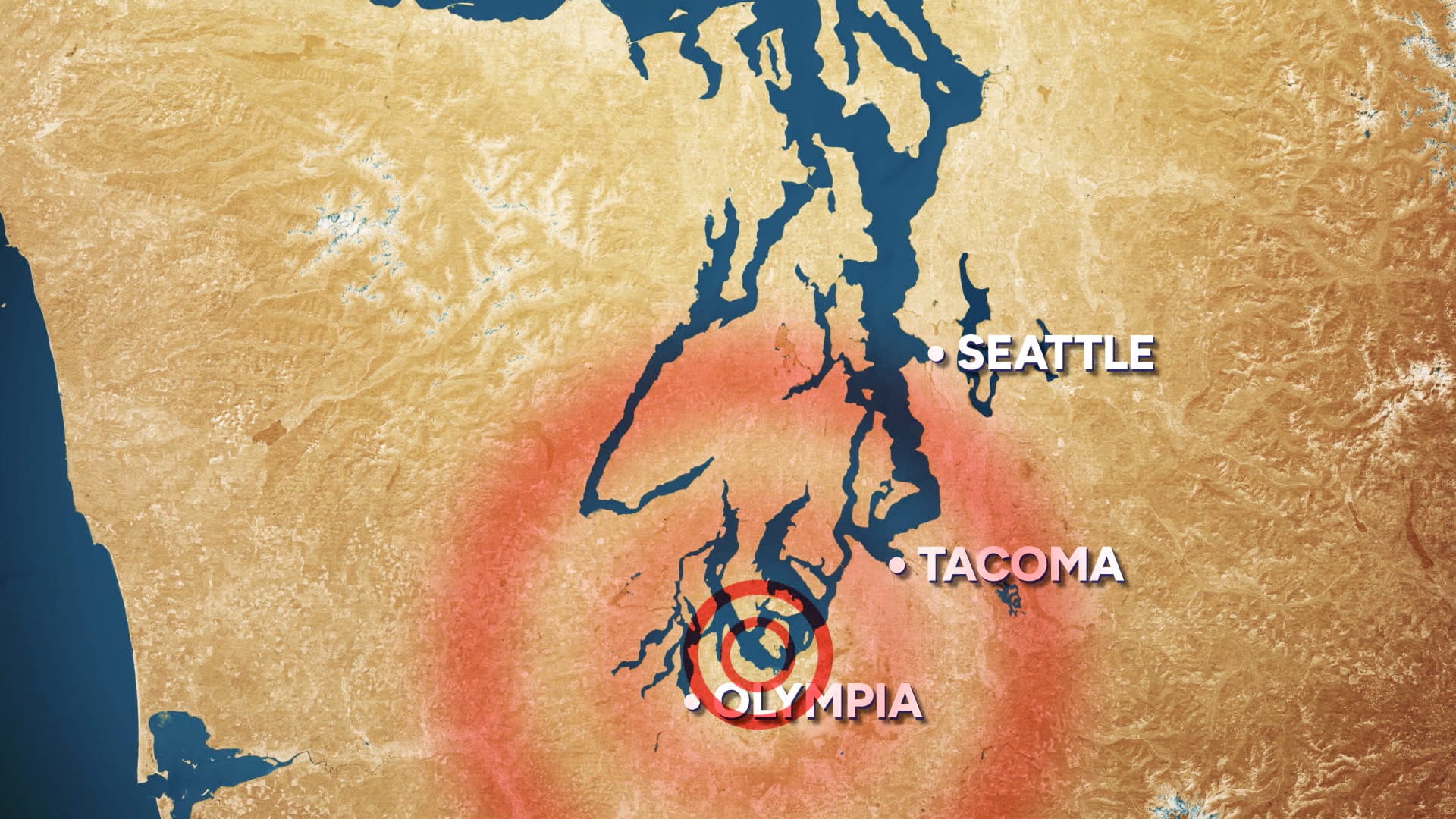
Long-timers all have memories of these. My father was a surgeon at Virginia Mason hospital in 1949 and remembered the quake hitting on April 13 near noon while he and another physician were scrubbing for surgery. The doc next to him jumped into the sink! Afterwards, my dad asked him why and his colleague replied that he’d been in the Philippines during a major quake and multi-story buildings fell down but left their plumbing standing, including sinks and toilets hanging from pipes in the air. The 1949 quake, centered between Olympia and Tacoma, did millions in damage and killed at least eight people. The 6.7 it was felt as far away as Montana.
Another rattled Seattle which hit at 8:29 am on April 29, 1965. I remember it vividly. I was at before-school orchestra practice at John Muir Elementary in south Seattle. The building shook, a friend dove under a table yelling “hit the dirt,” and our music teacher Mr. Bloom stood on his podium tuning a violin as if nothing was happening. I held my French horn above my head in case the ceiling fell in (it did crack). Interestingly, the old brick school was damaged and was eventually demolished and replaced.
The violent shaking in ‘65 impacted a live TV fashion show being broadcast from the Space Needle restaurant. This was a big test for the Needle whose consulting engineer, John Minasian, had insisted the tower’s design needed to be more earthquake-proof. One of the fashion models there that morning told me she was using a Needle elevator as a dressing room and as the Needle swayed she could see the ground 500 feet below between the elevator and the Needle’s floor. The tower swayed in a figure-eight pattern, as it was designed to do, and remained standing with only a few dishes broken and some nerves frayed.
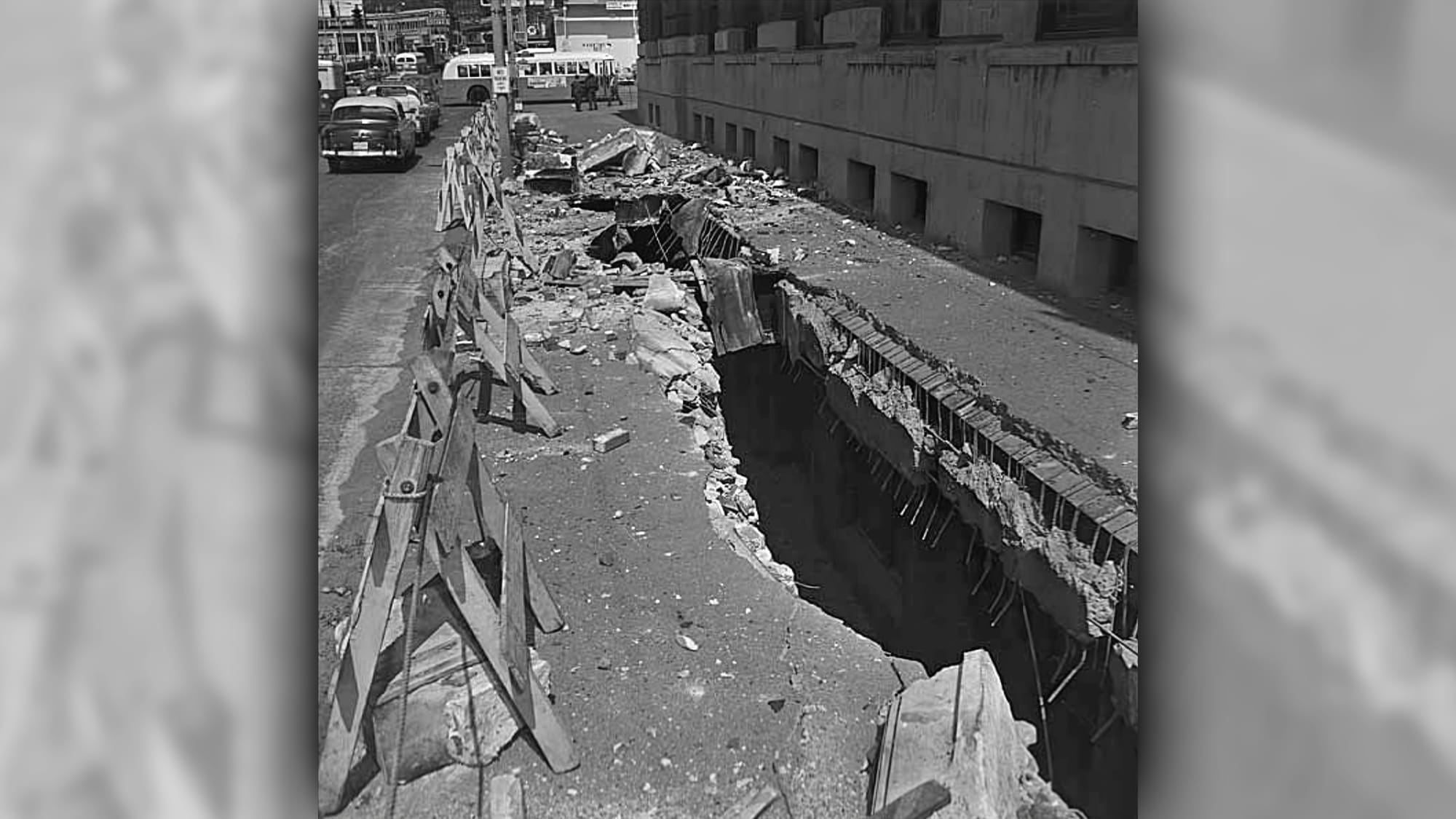
One thing in common with our quakes: Pioneer Square takes a big hit. Much of it is built on landfill that can liquify when the ground shakes. But also, in the ‘49, ‘65, and the 2001 Nisqually, major fallout was in the form of falling bricks. Buildings come down, facades collapse, chimneys topple. When Seattle burned down in 1889, the business district was rebuilt of stone and brick. That helped solve the fire problem but revealed an earthquake issue.
I missed the 2001 Nisqually Quake—I was in California that day—but Mossback producer Michael McClinton did not. He has a souvenir from it: a bent menorah that leapt off athe shelf mantlepiece inof his office in the Odd Fellows building on Capitol Hill. Queen Anne home. The quake struck close to 11 am on Feb. 28. The 6.8 quake was centered in the south Sound. Brick buildings in Seattle were hit hard. One person died, some 400 were injured in the area. As someone who saw the quake as reported on CNN that day the footage made it seem as if the entire city of Seattle was in ruins. It was a relief to find out my home and family were safe, but the initial TV impression was of devastation. When I went to work for FEMA later that year, I learned that coverage was called “the CNN effect.”
But the quake had some expensive consequences. The Alaskan Way Viaduct along Seattle waterfront was damaged and that led to a multi-billion-dollar effort to replace it with a deep underground highway tunnel and a remaking of the seawall along Elliott Bay. In a way the Nisqually knocked the viaduct down without knocking it down but revealed its vulnerability. It too had largely been built on land fill.
No story about quakes in Seattle would be complete without mentioning the Beast Quake of 2011 when the Seahawks’ Marshawn Lynch ran for an incredible game-winning touchdown against the New Orleans Saints during a playoff game in SoDo, the crowd’s pounding excitement measuring on seismic registers as a mild earthquake. Similar readings have since been recorded by Mariners, Sounders and Taylor Swift fans.
While we wait for the Big One and occasional regional quakes, we can make mini-quakes of our own with foot-stomping pleasure, though nothing powerful enough to make waves in Japan.
