


Landscape photographers strive to capture the natural environment in all its sheer and shocking beauty, often with the implicit message that this planet is worth protecting. Usually, the scenery is seen at a remove — an omniscient view, with the photographer only present in the imagined click of the shutter. But in the work of photographer Margeaux Walter, the human is very much in the picture.
You’re reading Art x NW, the weekly arts and culture newsletter from Cascade PBS. Read past issues and subscribe for more.
Born in Seattle and based in Joshua Tree, Walter says her focus is “deserts, forests, coastlines, dry lakebeds and floodwashed terrain… places shaped by extraction, drought, wildfire, erosion and ecological instability.” Her aim, as she states in the introduction to her beautiful new book Sedimental, is to “reframe these environments not as distant catastrophes, but as lived and continually changing spaces in precarious balance.”
Her method is immersive. Walter first chooses a location and photographs a segment of the landscape. She then prints that image onto fabric, which she sews into a garment. Next, she returns to the area, dons the garment, and photographs herself blending into the scene.
Across the pages of Sedimental, published by local fine-art photography press Minor Matters Books, Walter uses her site-specific camouflage to stand tall among a patch of burned trees in Yosemite, hunch like a rock in a pool at Pinnacles National Park, and assume the ombre pattern of a “hoodoo” at Bryce Canyon.
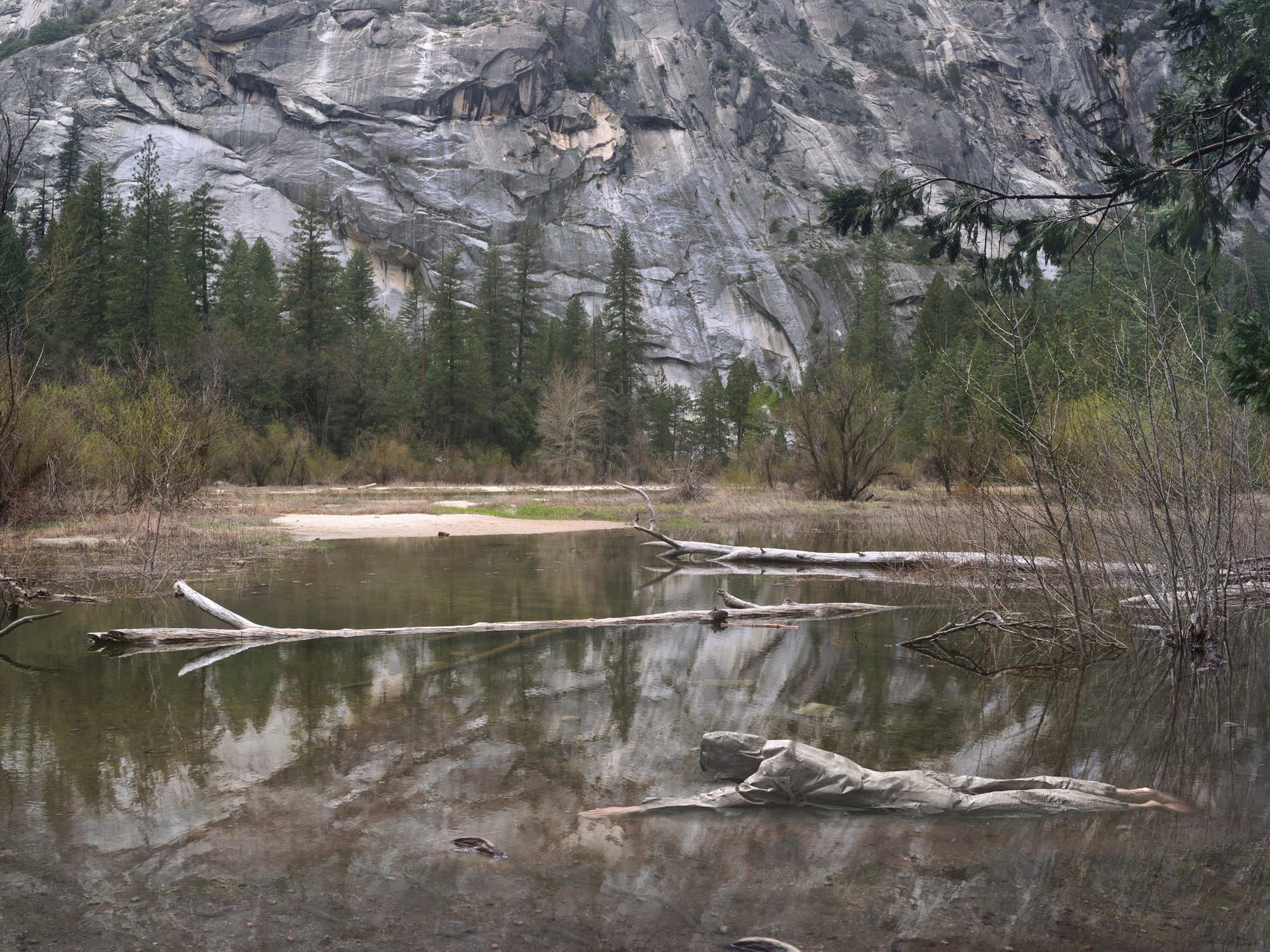
Despite her cloaking technique, she can be picked out fairly quickly in most of the shots. (An evolutionary alert system, our eyes are attuned to subtle aberrations in the natural setting.) In some images, Walter deliberately reveals a naked hand or foot, emphasizing the human impact on the land. But in several instances, we witness a blurring of the human/nature boundary, as when she seems to be actively melting into the wall of a cave.
Sometimes Walter can’t be seen at all, as if fully merged with the landscape. (I am still squinting to find her in several shots.)
As a whole, Sedimental reads as an intriguing mash-up of National Geographic, ecofeminist performance art and Where’s Waldo? Augmenting her environmental message is a clear love of the absurd. It’s funny to dress up like a saguaro and stretch your arms out in a classic cactus pose. It’s ridiculous to bury yourself in the sand among dried tumbleweeds and use one as a hairpiece.
But these curious scenes pull us closer — we can imagine ourselves dressing up like she does and slipping into the background. Walter’s images also point to our everpresent struggle with nature: desperately wanting to be a part of it, forever standing out awkwardly and oftentimes screwing it up entirely.
More books, the first two recently released from local Mountaineers Books, offer additional ways to disappear into nature.
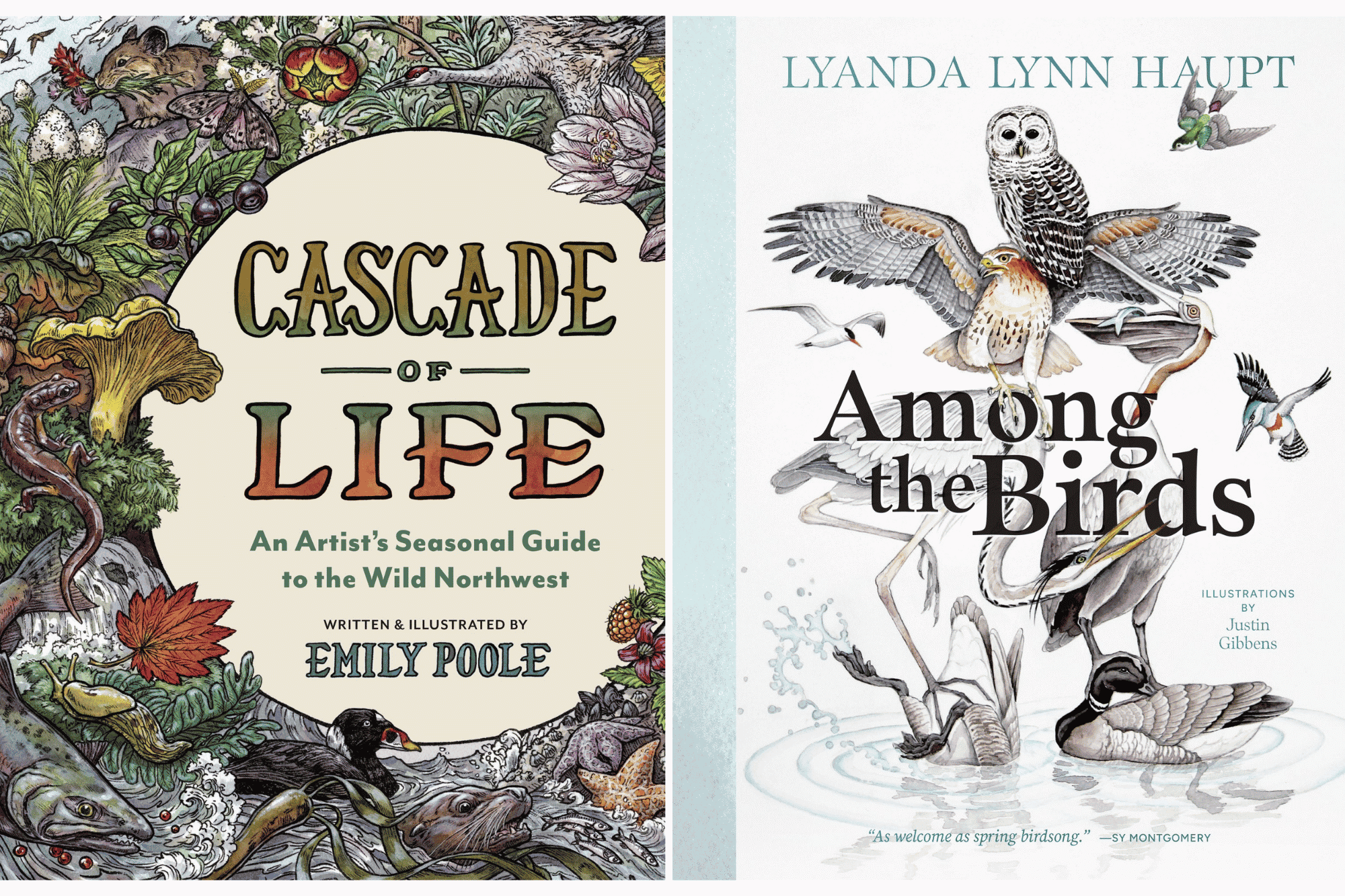
< Among the Birds: Field Notes from Cascadia. Bellingham-based nature writer Lyanda Lynn Haupt is a verified birdbrain, having written several popular nonfiction titles (Crow Planet; Mozart’s Starling) about the beaky majesty of our feathered friends.
In this new book, Haupt shares personal essays and natural history about the birds surrounding her home. Steller’s jays, Anna’s hummingbirds and black oystercatchers are among some 70 that alight on the pages. These are accompanied by a flock of playful illustrations by Thorp artist Justin Gibbens (profiled in Art by Northwest: Season 2). One of Haupt’s insights: Even a run-of-the-mill robin can offer a lesson in careful attention. Haupt will be in conversation with nature writer David B. Williams at Town Hall Seattle (Dec. 1 at 7:30 p.m.).
< Cascade of Life: An Artist’s Seasonal Guide to the Wild Northwest. Written by Oregon-based illustrator and naturalist Emily Poole, this lovely and engaging guide elucidates the flora and fauna of wider Cascadia.
Organized by biomes (coast, lowlands, mountains, drylands) as well as seasons, Poole’s book is packed with paintings, personal insights from her sketchbook excursions and interesting tidbits about everything from rainbow lichen to Western fence lizards, glacier lilies to sandhill cranes. Her hot take on the coast: “What I like most is that once you start poking through the rocks… it’s just plain weird.” She’ll talk about the book at Third Place Books Seward Park (Oct. 29 at 7 p.m.).
And heads up: Seattle photographer Eirik Johnson also has a new book out, Leviathan Rising (from MW Editions in NY), showcasing his stunning, close-up images of the horizontal line where immense, rusty barges meet the surface of water. Abstract and beautiful, the images are also eerie (look up submechanophobia). More on this one when Johnson’s accompanying solo exhibit of photos — which he takes from his sea kayak — lands at Tacoma Art Museum (Oct. 29 — Jan. 24).
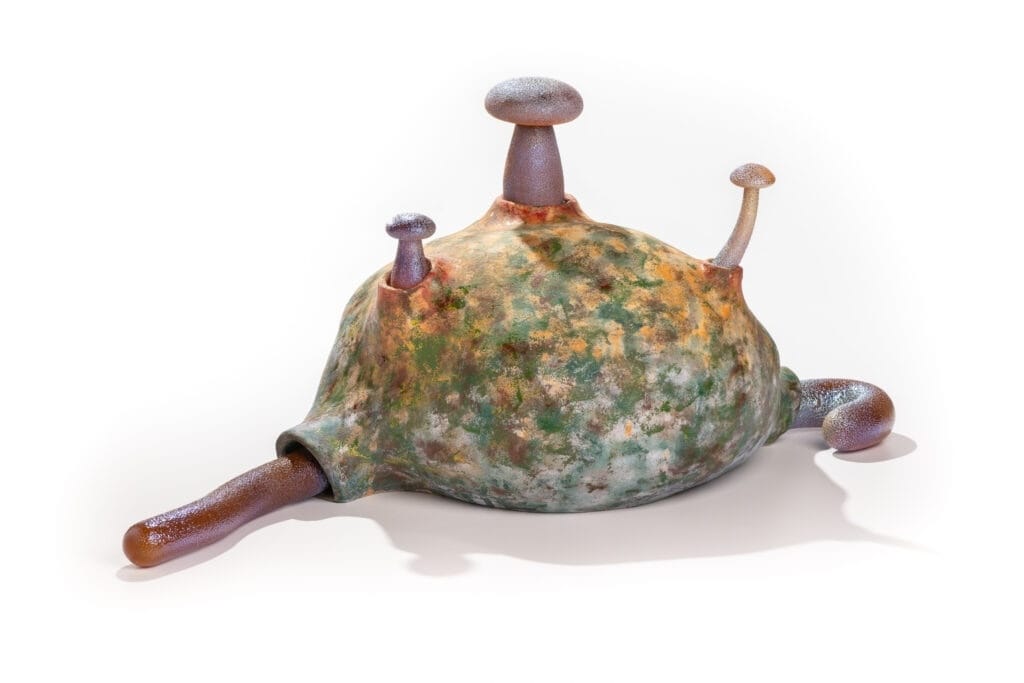
At Traver Gallery, sculptor Granite Calimpong has a weird and wonderful show called Under the Bank, Up a Narrow Valley (through Oct. 31; artist talk Oct. 24, 2 p.m.) These clumpy, colorful and pleasing mini-landscapes reflect the artist’s explorations of the West Coast: both California, where he grew up, and the Northwest, where he lives.
Made from glass and ceramic materials Calimpong’s pieces look at first like extraterrestrial scenes — with slick red pools and blue rock formations and tubes jutting out at odd angles. But stay for a while and they resolve into an organic familiarity. Suddenly you’ll see all the good ole stuff: slugs and mushrooms, logs, crags, lichen and even a downpour. They’re still here, if slightly skewed, hurriedly adapting to our swiftly changing planet.
At the Museum of Northwest Art in La Conner, Surge: A Geography of Flow is back (through Jan. 10) with a new roster of artists. This annual group show — a favorite of mine — pairs regional artists with local scientists to create new works addressing climate change. There’s a lot of great work here, including Niki Keenan’s abstracted nurse log, Kelsey Fernkopf and Steve Gilbert’s neon woodland disruptions, and deep forest-floor photography by Melinda Hurst Frye (profiled in Art by Northwest Season 2).
While you’re up North, stop by Perry and Carlson Gallery in Mount Vernon to see the latest from Skagit Valley artist Todd Horton (profiled in Art by Northwest Season 1). For Topographic Meditations (through Nov. 1), he wrapped canvas around pier pilings and trees, left it to weather for a month, and worked the results into abstract wall hangings that speak to the passage of time.
Downtown, at Woodside Braseth Gallery, Northwest painter Jared Rue is sharing Everywhen (through Nov. 15), a collection of serene tree-laced views that glimmer with metal leaf. And in Return to Romanticism at Chatwin Arts in Pioneer Square (through Oct. 31), another Northwest painter, Laura Hamje, is showing lush green landscapes inspired by a recent trip to Italy.
Lastly, for a completely different sort of immersion, longtime Seattle-based Swinomish artist Daniel R. Smith is staging a nature-takeover of the Padelford Garage at the University of Washington. Part of a UW event series on Indigenous modes of understanding, Spot Reservation (Oct. 30, 11 a.m. - 3 p.m., garage level N21) will create a “nanoforest” in a parking lot. Expect native plants sprouting from oil barrels, wearable taxidermy, live raptor demos and fry bread tacos. Smith says this pop-up “occupation” is celebratory, interactive and open to all. Intrigued? He’ll give a talk about Spot Reservation a few days prior (Oct. 26, 10:30 a.m. at UW’s Intellectual House). Or just attend and relish the paradise-paves-over-a-parking-lot of it all.
All eight new episodes of Art by Northwest Season 3 are now out in the world! Have you seen each and every one? Catch up on Art by Northwest, nominated for two Northwest Regional Emmy Awards.
