


For decades, ceramicist Randy McClelland asked himself the question so many artists ponder: When can I quit my day job and devote myself to making art?
After taking elective clay classes in high school and at Clatsop Community College, he spent years throwing pots in his off hours. That includes during a 16-year career in medical administration at Columbia Memorial Hospital in Astoria, Oregon. During the work day, McClelland was a Director of Strategy and led a facility expansion project. In his spare time, he devoted another 20 hours a week to honing his kiln skills and expanding his pottery chops.
You’re reading Art x NW, the weekly arts and culture newsletter from Cascade PBS. Read past issues and subscribe for more.
Around 2012, his wood-fired stoneware started getting noticed, and was featured in gallery shows along the Oregon coast. He continued to balance his career and his passion — even curating group art shows at the hospital — but in the back of his mind, McClelland recalls thinking, “When can I pull that trigger and make art full time?” He started taking big, daunting steps toward the dream.
In 2021, he bought a forested 5.5-acre property in tiny Naselle, Washington, just across the Columbia River from Astoria. He spent the next couple years building a wood-fired kiln, brick by brick, in the manabigama style — a hybrid of the Japanese anagama kiln and an American cross-draft kiln. He dubbed it Neiseru Gama (Naselle Kiln), and completed his first firing in 2024. And at long last, he became a full-time artist.
Stream the episode now or watch the broadcast premiere on Cascade PBS, tonight at 8:50 p.m.
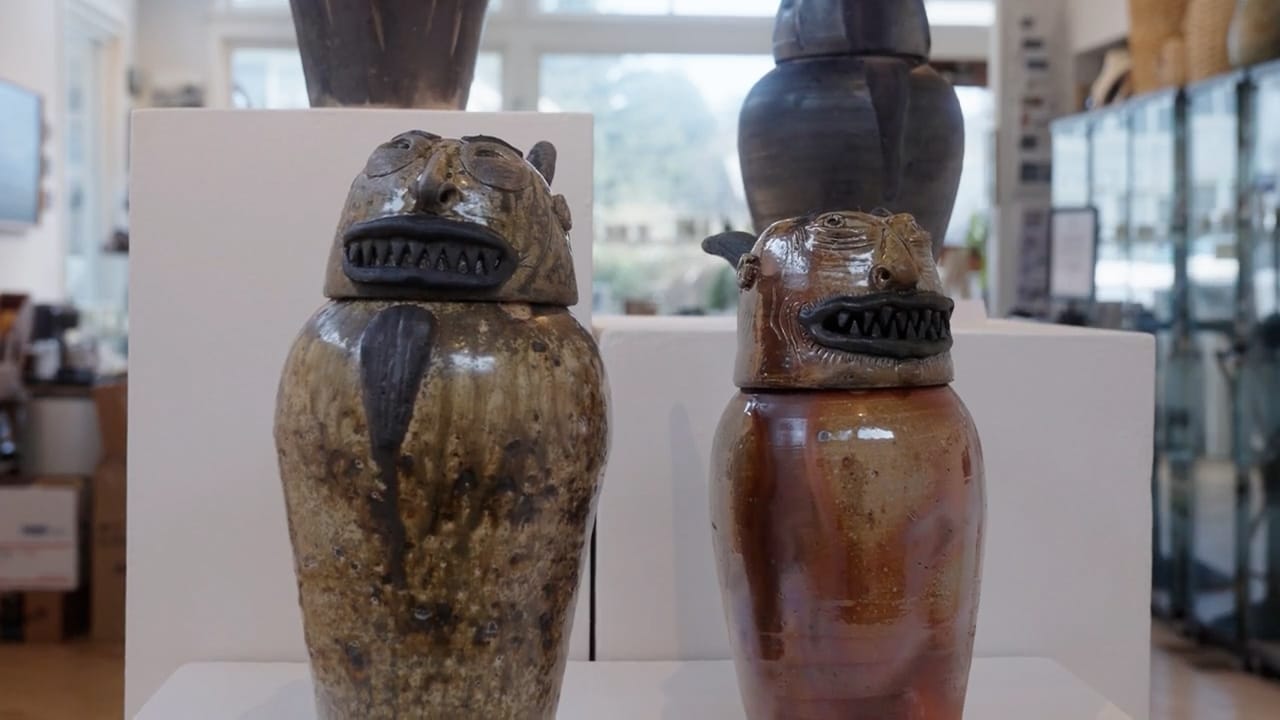
On his website McClelland calls himself “Hafu Potter,” a nod to the Japanese term for someone who is half-Japanese. In his case, the Japanese heritage comes from his mother’s side — a legacy that factors heavily into the style of his sculptural work, which often depicts figures from Japanese mythology.
His lofty home studio is filled with clay faces: curious creatures with fish tails, broken teeth or hugely oversized noses, maybe a loyal crow or a crab demon, a monster with a single eye — each one with a story. These narrative pieces emerged thanks to a cultural immersion during his teen years.
After an early childhood in South Florida, McClelland moved to Tokyo to attend the American School in Japan from eighth grade through high school (1984-1989). The experience was influential on multiple levels.
It was where he took his first ceramics class, in 1986, under Ki Nimori. It was where his aunt gave him a tengu mask, the kind traditionally used in Noh theater, which inspired his interest in sculpting dramatic faces. And it was where he learned about mischievous yōkai characters from Japanese folklore and supernatural gaki, or “hungry ghosts,” from Buddhist cosmology.
All of the above show up in the pieces McClelland makes now, which include whiskey jugs, lidded jars and ornamental vases — vessels that are both functional and sculptural. The faces he creates in clay are remarkably expressive, whether whimsical, grumpy or devilish. McClelland points to another artistic influence: the evocative “face jugs” made by enslaved potters in the mid-19th-century American South, which he learned about over his years of ceramic study. “My work is a confluence of cultures,” he says.
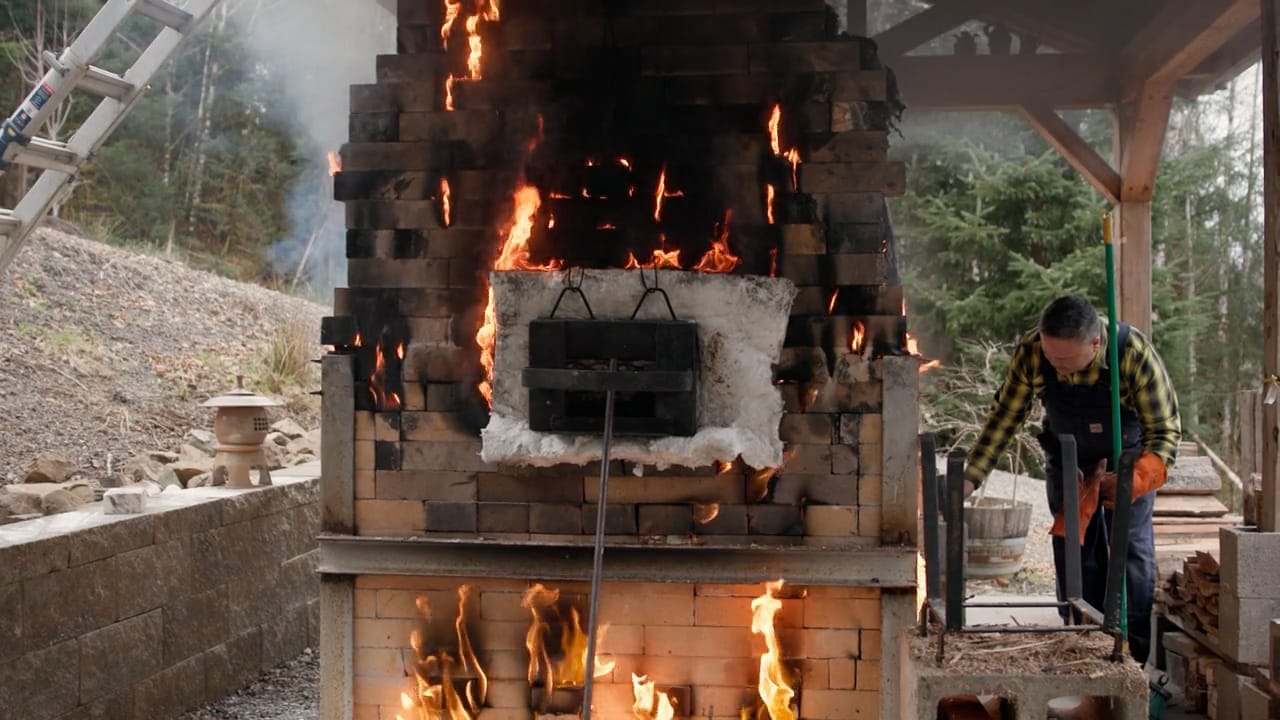
That confluence includes a literal incorporation of his immediate surroundings in Naselle: fallen alder from his property, donated maple from a local lumber mill, Douglas fir pilings pulled from the Columbia River (some still covered in barnacles), all used to fire his kiln.
“The wood is the most important material in my clay practice,” McClelland says. “If it’s not prepared correctly, you can’t finish your pots.” He frequently experiments with different wood to see how it reacts and affects the surface of the artworks. Since McClelland doesn’t use glazes, the surface markings come partly from the ash that flies around inside the flaming kiln.
The earthy look of the pots is also achieved by his incorporation of natural materials into the clay itself — mixing foxglove ash, kelp or mud from the banks of the Naselle River into a commercial base. “Commercial clay has no soul,” McClelland says. “When I make my pots I like to see evidence of the place where I live.”
He’s especially fond of using crab shells that wash up on local beaches, which he often crushes in a coffee-bean grinder and combines with a watery clay “slip” he paints across the surface. “There’s some element of local material in every piece,” he says. “It adds character and randomness… which make nice variations.”
McClelland loves the ritual of lighting, stoking and loading his kiln, both for the camaraderie it fosters among his community of potters and for the surprising results the technique produces in pots. During the colder, wetter months of the year, he orchestrates 48-hour firings that must be stoked and monitored constantly. Various regional potters join in, adding their own works to McClelland’s creatures in the kiln. He prizes this lengthy process because it keeps the humans up all night, echoing the stressful conditions the pots must endure — honoring the long road to achieve transformation.
Save the date for a winter road trip to McClelland’s next show at Riversea Gallery in Astoria, OR (Dec. 11 - Jan. 4; artist reception Dec. 12).
Watch Art by Northwest Season 3, Episode 8, profiling ceramic artist Randy McClelland and catch up on past episodes of Art by Northwest, nominated for two Northwest Regional Emmy Awards.
