


Like the best origin stories, Manolo Aguilera’s starts with a near miss. As a teenager at Everett High School, in the early 2000s, he happened to meet longtime glass artist James Mongrain. A neighbor had connected them; Mongrain had a studio in Mukilteo and needed help sanding a large piece. Noting the young Aguilera’s interest and work ethic, Mongrain arranged for another work opportunity — this time at a glass studio in Seattle.
But Aguilera was just a 17-year-old kid. He had only recently moved here with his family from Veracruz, Mexico, and was still working on his English. So he took down the address for the Seattle gig but got lost and couldn’t find the building. Embarrassed, he went home and didn’t follow up with Mongrain.
About a year later, they bumped into each other at a grocery store, and Mongrain recommended Aguilera try again. This time he found the Seattle studio, which turned out to be Dale Chihuly’s famed boat house. Aguilera has been working there ever since.
You’re reading Art x NW, a weekly arts and culture newsletter from Cascade PBS. Read past issues and subscribe for more.
Aguilera (whose full name is Emmanuel Aguilera-Santos) started as a loader in the hotshop, moving raw glass materials into the furnace, and transporting finished pieces into the cooling oven. He says for the first 10 years he approached the job with a focus on learning the basics and moving up to a gaffer position. Then something clicked and he wanted to learn and explore more.
“I’d always heard that if you can make a goblet, it means you’re a really good glassblower,” Aguilera recalls.
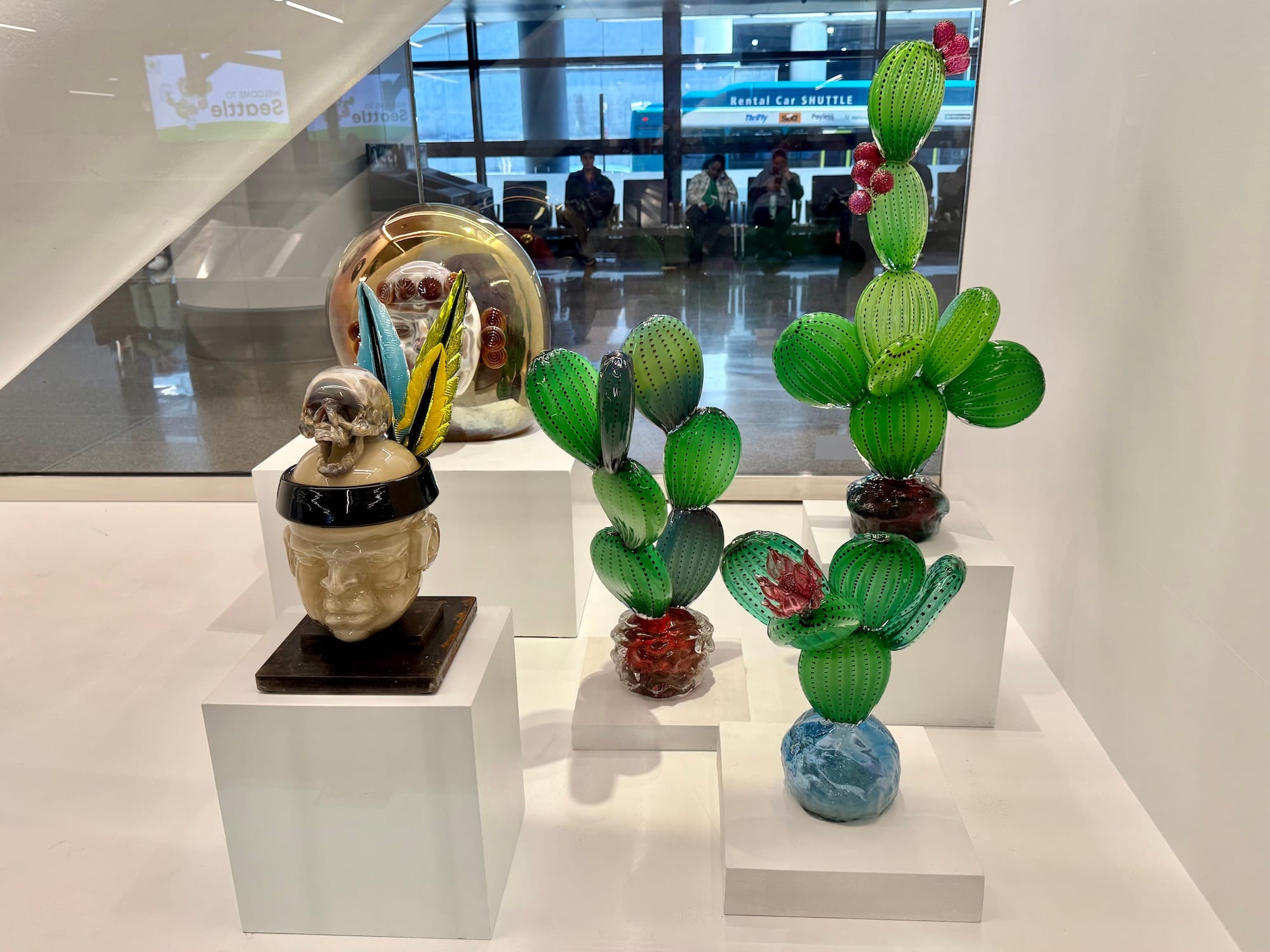
So he set himself to the task, and spent the next seven years perfecting the classic Venetian form. And he noticed something about the decorative dots on many goblets. “Every time I would look at it… they just looked like something that a cactus would have where the needle is on the plant,” Aguilera says. Once he felt comfortable making a goblet, he played with the form, translating it into cactus pads, or nopales, as seen in the hardy plants he remembered from Mexico.
Growing up in Veracruz, Aguilera was surrounded by the art of his ancestors. Considered the cradle of Mesoamerican culture, the city spawned ornamental architecture, intricate pottery and ceramic figurines, as well as the colossal Olmec heads made from boulders. As he developed his glass style, Aguilera found himself exploring these artistic traditions as a way to connect with his heritage.
The Pacific Northwest has a notable contingent of Indigenous glass artists — including Preston Singletary, Dan Friday and Raven Skyriver — whose work pays homage to ancestral traditions. “I have Native friends who are glassblowers here,” Aguilera says. “I wanted to honor where I’m coming from too.” After a 23andMe test confirmed his own Indigenous Mexican ancestry, he felt even more drawn to make work that reflected his roots.
He does so with the nopales sculptures that have become his signature, their translucent green pads peppered with needle-dots and glass flowers in all colors. He also sculpts large heads from molten glass, their faces inspired by Olmec figures and Aztec deities. With headdresses, elaborate jewelry, and sometimes extra skulls, these Mesoamerican gods and mystics tell stories from another time. In Aguilera’s hands they’re imbued with contemporary relevance, as well as his own Pacific Northwest influences.
When Aguilera found his way to Chihuly’s studio back in 2004, he’d never heard of the Northwest glassblowing legend. But as a young apprentice he soon learned about the glass master’s long history, including his co-founding of the legendary Pilchuck Glass School. Aguilera took his first class at Pilchuck in 2008, and was blown away by the history and beauty at the forested Stanwood campus. “I saw a lot of things I’d never seen before in the hotshop,” he recalls.
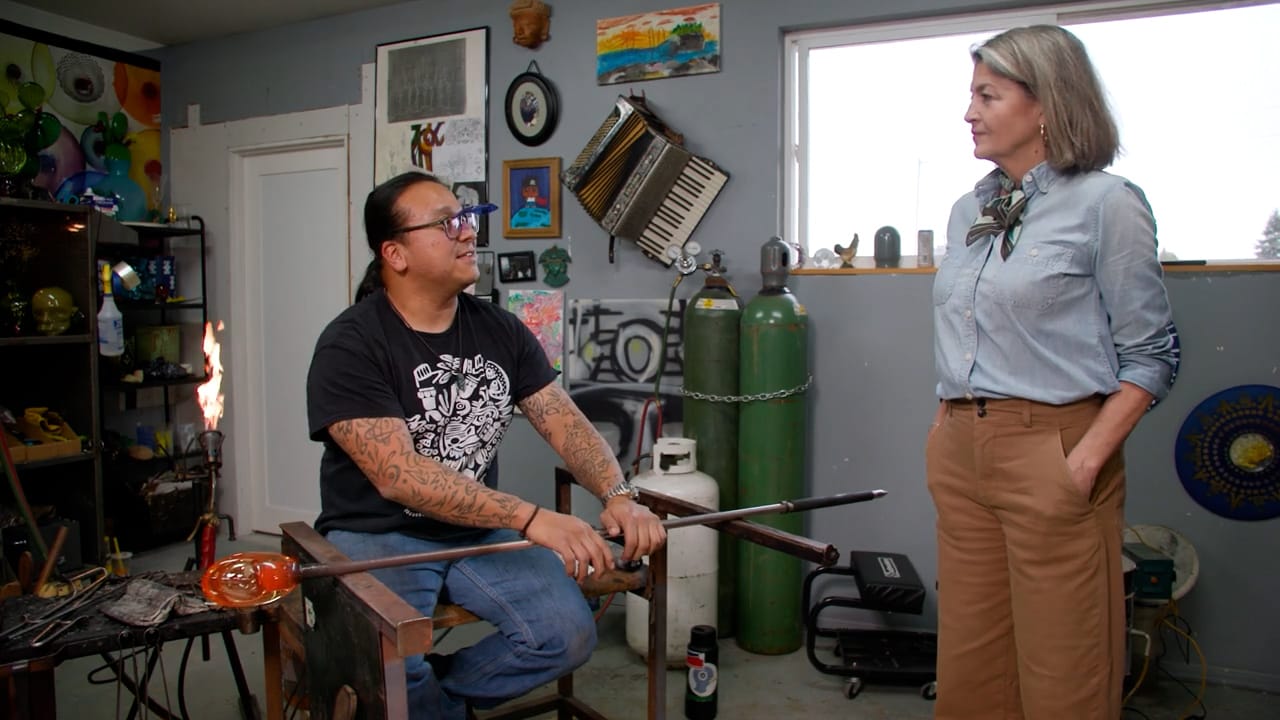
Glassblowing wasn’t the only art form Aguilera was pursuing during this time. A competitive salsa dancer, he also spent a decade teaching classes in the Latin dance form. In 2015, he built out a backyard studio in order to teach private lessons from home.
But as his pursuit of glass grew more passionate, he decided to turn the dance studio into a small hotshop, bringing in all the industrial equipment he’d need — including a furnace, a glory hole and an annealing oven. He started pulling it together in 2022, and since then his primary choreography has involved carrying molten glass across the room, spinning blowpipes and making careful gestures to perfect the features of his glass faces.
Aguilera says it takes 30 years to become a glass master, “so I have nine more to go.” In a full circle moment for his Northwest glass story, he now teaches workshops at Pilchuck and recently made history at the school by leading its first glass class taught in Spanish.
“The beauty of it was that I was able to connect with so many other artists,” he says fondly. “We share the same history and experience of being immigrants … It just made it so unique and special.”
Watch Art by Northwest Season 3, Episode 6, profiling Manolo Aguilera, and stay tuned for two more artists from around the region. While you wait, catch up on past episodes of Art by Northwest, nominated for two Northwest Regional Emmy Awards.
