


For the past 16 years, Native Hawaiian artist Miki’ala Souza has lived at the turbulent confluence of the Columbia River and the Pacific Ocean. But her home in Astoria, Oregon, overlooking Youngs Bay, is only the most recent of her waterside abodes.
You’re reading Art x NW, a weekly arts and culture newsletter from Cascade PBS. Read past issues and subscribe for more.
She was born and raised in Honolulu, highly attuned to her natural surroundings, and spent years living between Portland and Hawaii, as well as a stint in the Solomon Islands. “I think about water a lot,” she says, “and its ability to move and connect all of us.”
That’s evident in her artwork: monotype prints of windswept seascapes that evoke currents, waterways and migration. These richly hued works alternately suggest soft clouds and dark storms and fiery sunsets. Some include crescent shapes that when vertical resemble spinnakers, when horizontal, Indigenous canoes. No people are present but you imagine them nonetheless, making their way across water.
(Stream this episode of Art by Northwest now, or watch the broadcast premiere on Cascade PBS, tonight at 8:50 p.m.)
Souza was raised by artist parents — her mother is a fiber artist who works in lauhala leaf weaving, her father is a ceramicist, sculptor and musician. But Souza was drawn to 2D arts, and left Hawaii in 1999 to study painting and drawing at the University of Oregon. After moving to Astoria in 2010, she enrolled in a printmaking class at Clatsop Community College. It was there she met an artistic mentor, Royal Nebeker, and shifted her artistic focus to prints.
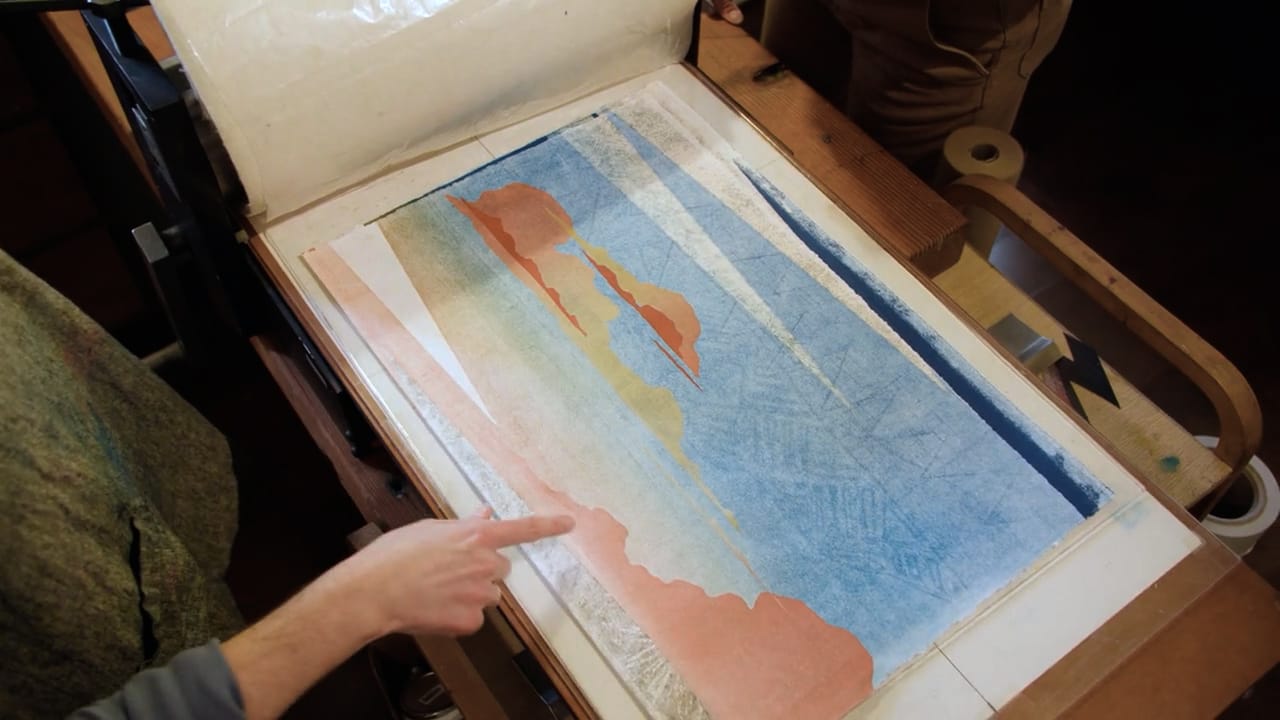
Considered the most painterly style of printmaking, the monotype process creates a single, unique image — one that’s always a bit of a surprise coming off the press. “I really like the chaos and unpredictable nature of them,” she says. Souza starts by rolling thick printer’s ink onto a plexiglass surface, often using a rag to remove sections here and there. Then she prints the plexiglass image onto heavy cotton paper, setting the background for the seascape.
Color is key to Souza’s work, whether fuschia and orange reminiscent of Hawaiian flora or moody blue-grays suggesting Astoria in a storm. Using a process called relief collage, she adds pieces of previously printed, stenciled or delicate cut-paper shapes to the background — instinctively guiding the ebb and flow of her invented landscapes. These stockpiled and repurposed scraps are leftover from earlier works and can be many years old. As such, they serve as a sort of mooring line, tying her works together across an artistic timeline.
Once the collage elements have been added to the printed background, Souza sends the whole piece through the press once again (maybe more). In this way she connects the layers as one image, adding depth, shadow and movement to the flat surface.
Souza is interested in layers of place — the historical records, environmental changes and political shifts that pile up in one location. “Some things get obliterated,” she notes. “My work is a metaphor for what a place becomes over time, as we pass through and leave an impression.”
Her monotypes reflect this idea with layers of pattern, texture and ink. Sometimes an underlying layer gets completely covered by a new addition, but it still lies beneath, adding to the origin story.
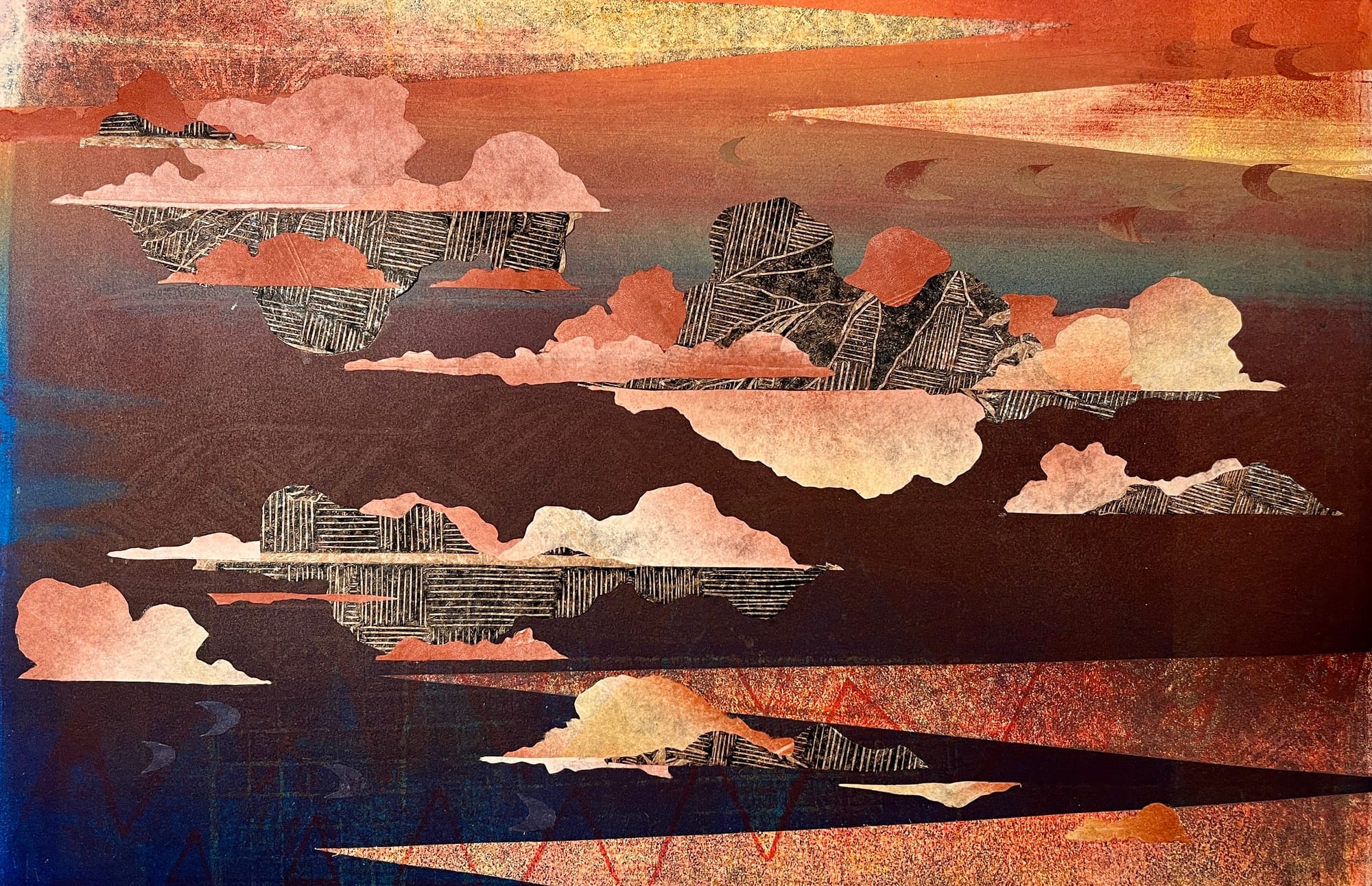
The direction Souza finds herself looking toward is west, across the ocean toward her Hawaiian family and ancestors. Lately she’s been thinking about the ancient Hawaiian tradition of kapa, or bark cloth, which was often decorated with repeating floral and island motifs. “There was a lot of geometric movement throughout those pieces,” she says. “I find that really inspiring, how they break up those spaces.”
At nearby Fort Stevens, where the Pacific Ocean meets the Columbia River, Souza is reminded of the way water currents connect people across great expanses. The interpersonal connection might be subconscious, or felt as deeply as homesickness. “I live here, I have an impact here,” she says, “but I can also impact someone in the next state, or on an island 3,000 miles away.”
You can experience Souza’s dreamlike scenes in person at DISplace, a group show of work by Native Hawaiian artists at the Wing Luke Museum (through Jan. 4, 2027). She’ll also have pieces in the group show Temporal, featuring contemporary Indigenous artists of the Pacific Northwest, at the Thurston County Museum of Fine Arts in Olympia (Oct. 2 - Dec. 11). And early next year, plan to visit her solo show at Imogen Gallery in Astoria (opening March 13, 2027). Worth traveling for, by land or sea.
Watch Art by Northwest Season 3, Episode 5, profiling Miki'ala Souza, and stay tuned for three more artists from across the region. While you wait, catch up on past episodes of Art by Northwest, nominated for two Northwest Regional Emmy Awards.
