


Spend a few days with sculptor Aisha Harrison and you may start to feel your scalp sprouting branches. Working primarily in clay, the artist creates captivating figures that blur the boundary between human and nature. Thickly visceral, the sculptures make you hyperaware of your own body and the bones beneath.
In one piece, a woman’s braids turn into roots; in another, a human figure emerges from a vine-covered snag; in yet another a pile of cupped hands are knit with twigs and lichen, suggesting a nest.
You’re reading Art x NW, a weekly arts and culture newsletter from Cascade PBS. Read past issues and subscribe for more.
“I definitely feel like I was a tree in a past life,” Harrison told me, when I interviewed them at their home studio for Art by Northwest. “It’s weird. Sometimes my bed is full of pine needles… like, where did that even come from?”
It seems slightly less weird when you see where Harrison lives: just outside Olympia on the Cooper Point peninsula, a narrow tongue of land that splits local waters into Eld and Budd inlets. Their family has owned acreage in this leafy neighborhood for four generations, including wild and wooded property where several bigleaf maples grow. “I have a hard time scraping the moss off my stairs,” Harrison noted in a recent artist statement.
Harrison’s artistic attention to the outdoors came early, thanks to their mother, Lucia Harrison, a book artist and former art professor at Evergreen College whose work reflects the ecology of the South Sound. At first, Harrison resisted representing nature in their own art — out of a simple desire to go a different direction. But eventually, the pull proved impossible to resist. “Because we are, actually, a part of nature,” Harrison reminded.
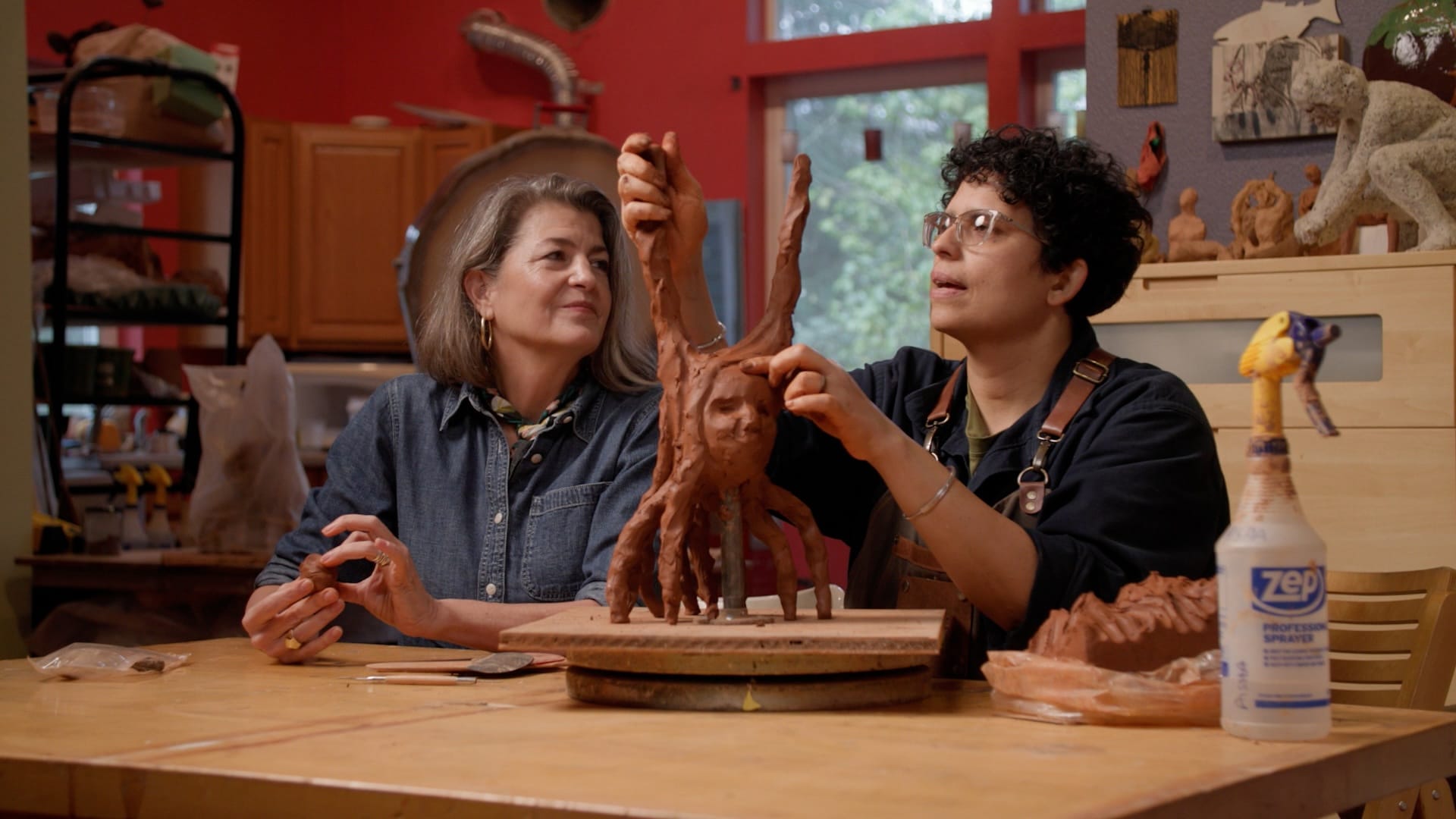
Harrison’s watershed moment with clay happened in an unlikely location: a former men’s locker room at Grinnell College, where Harrison was a Spanish major. Just for fun, they decided to take a class led by ceramics majors in the old gym. “I went there and started working with it, and it just… took over my life,” Harrison recalled. “It gripped me like nothing else.” In the basement gym, they earned the addictive thrill of throwing on a wheel.
After college, they continued to pursue clay classes, at Callanwolde Fine Arts Center in Atlanta, and Penland School of Crafts in North Carolina. At the latter, Harrison was initially annoyed when they couldn’t get into a throwing class and had to take a figure sculpting class instead. “And the rest is history,” they said.
Now Harrison begins most clay works with an art-therapy technique called “touch drawing” (developed by Deborah Koff-Chapin). Using tissue paper and ink to create quick finger paintings — maybe 50 in one sitting — of whatever comes to mind, Harrison feels able to connect with the subconscious, the environment and Black ancestors on their father’s side. Sometimes the ancestors send clues about what to shape, sometimes they encourage Harrison to sing.
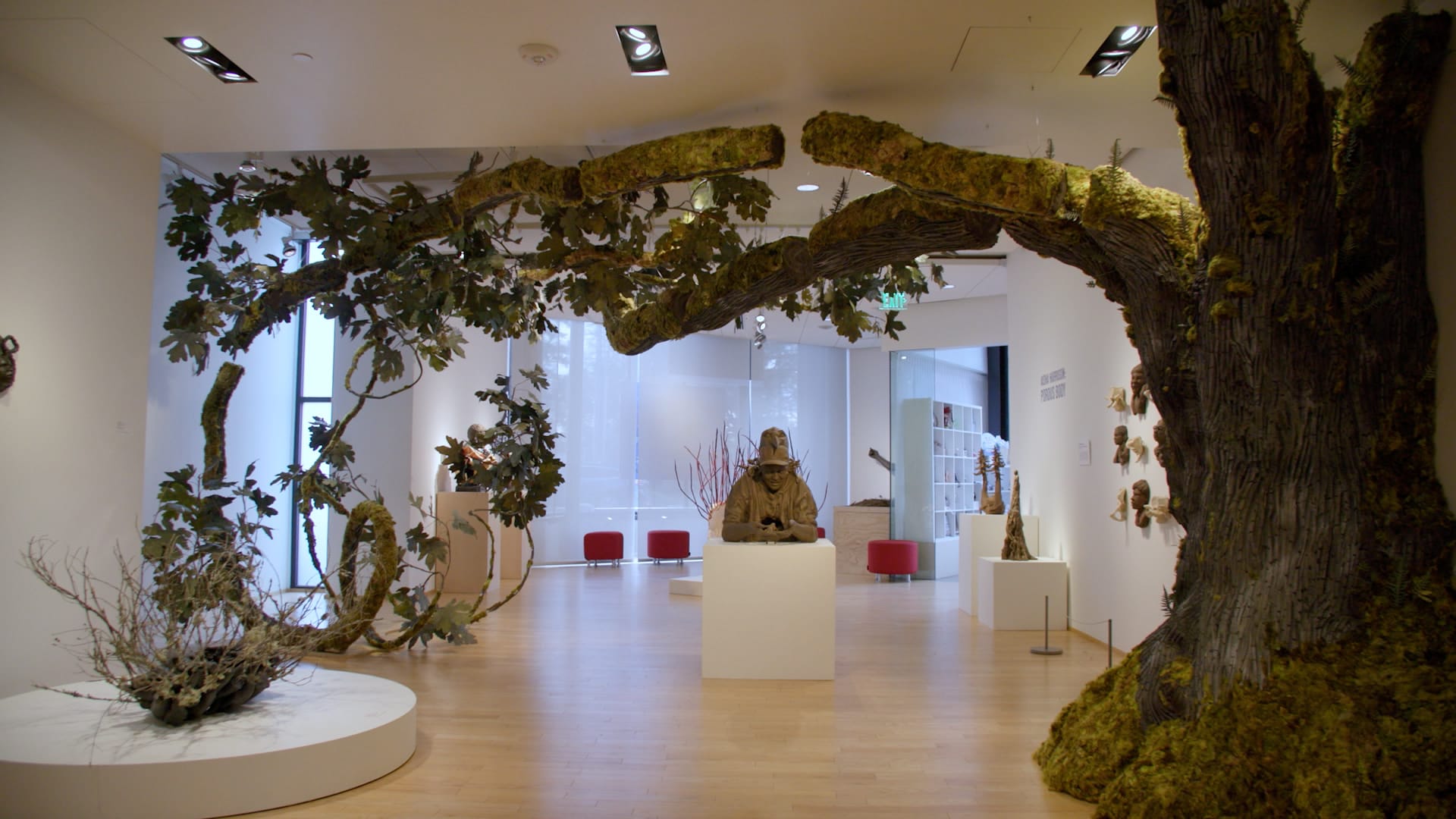
Walking into the installation process of Harrison’s solo show at the Bainbridge Island Museum of Art this past November felt like stepping backstage on opening night. Some 15 museum staff and volunteers were buzzing around, arranging plinths, unboxing clay busts and suspending large branches of an enormous bigleaf maple sculpture from the ceiling.
An homage to the disappearing Northwest species, Harrison’s tree sculpture — called “Love Letter” — had been in progress for two years. It’s an amalgamation of several bigleaf maples Harrison has spent time with, in Hoodsport, the Hoh Rainforest and on their family property. Carved from pink foam (for transportability), the tree was covered in 200 fern fronds, 600 leaves and untold clumps of moss — all made of paper, felt and wool by a team of 30 community volunteers, including Harrison’s mother, partner and child.
The bigleaf maple served as an anchor and arbor for the show, Porous Body (which closed in February). As the tree sculpture came together, so did Harrison’s clay figures. With each one lifted out of its crate, the gallery felt more and more like a gathering of ancestors. Some had exposed vertebrae, some had hair braided as strong as nautical rope, one exhaled a menagerie of woodland creatures.
At the end of installation day the volunteers had gone home and the room was finally hushed. Harrison stood beside a raised open display box, quietly moving their hands through dark earth into which was pressed a disembodied clay arm. First they could be heard humming, then singing softly.
Harrison’s most recent project required another massive effort in foam, clay and community: a life-sized bronze table, bench and seated figure, commissioned for the campus of UW-Tacoma.
Called “What We Tend Will Grow,” the piece is rooted by an androgynous central figure, who leans over the table with a baby on their back. Harrison spent months carving the armature from pink foam — a challenging medium to make realistic — before covering the piece in a thin oil clay and having it cast in bronze at a foundry.
The surface of the table resembles a lotus pod, and is embedded with 350 small seeds, each made from clay by a community member during “seed sessions” with Harrison across Tacoma. “Everyone made a small sculpture of their hope for the future,” Harrison explained, with the intention of “creating a feeling of belonging.” A bear, a hand, a woman, an avocado — the story behind each seed remains mysterious, but together they feel like a chorus of voices lifted in song.
One of the seeds was made by Dr. Maxine Mimms, founder of Evergreen State College’s Tacoma campus and a renowned Black leader in the Northwest. Mimms died in 2024, but had spoken often of the power of the kitchen table as an organizing and teaching space. Once cast and completed (installation is planned for early 2027), the piece will be interactive, inviting people to gather, sit and converse, as you would at a kitchen table.
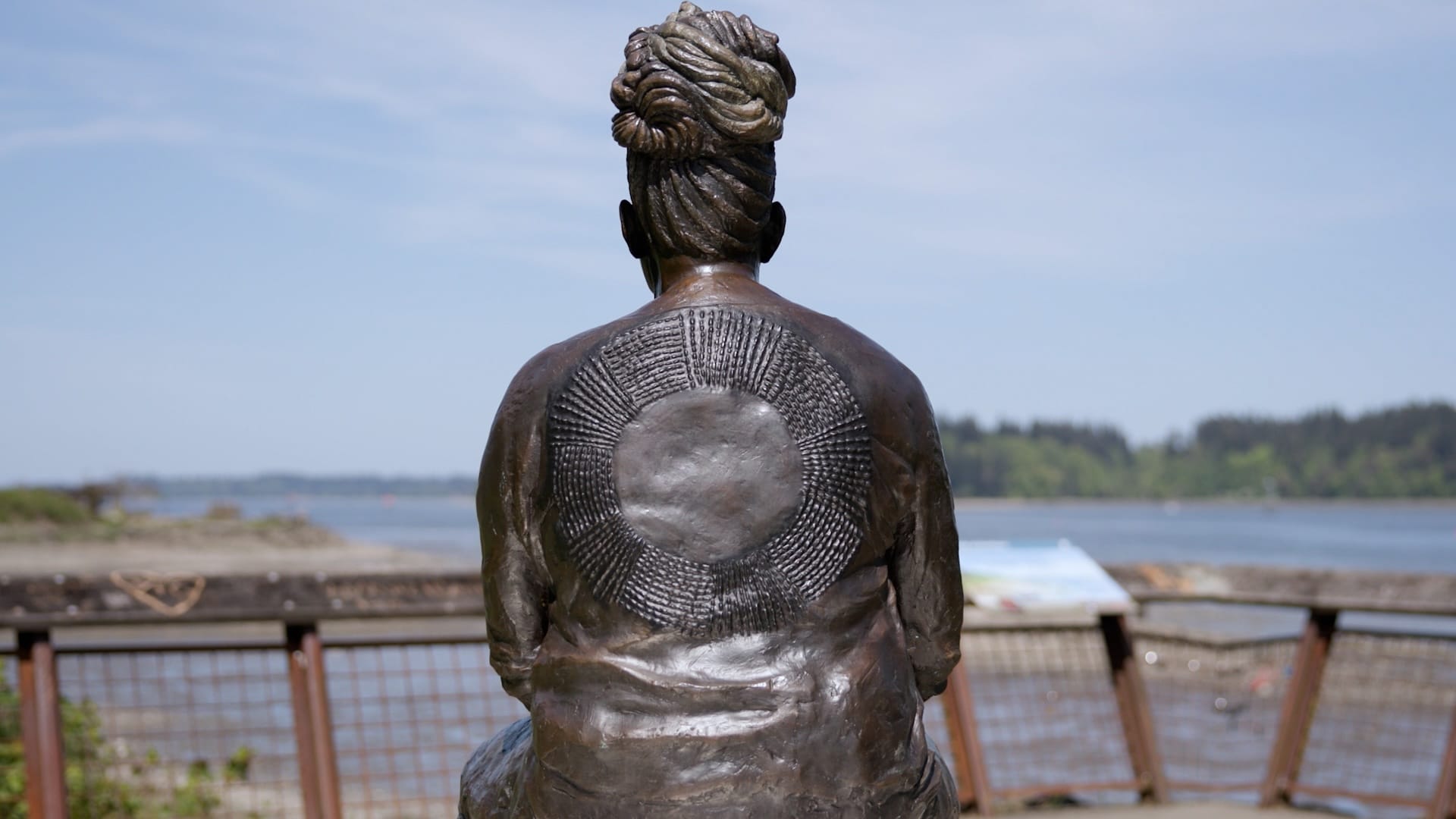
Harrison’s previous public artwork is interactive too, though in that case it happened accidentally. “Woman with Graves at Her Back” sits at the water’s edge in Olympia’s West Bay Park. The figure represents an ancestor Harrison has connected with during the touch drawing sessions, someone who arrived on these shores enslaved.
The woman has braided hair wrapped atop her head and an exposed rib cage, the bare bones visible above an open body cavity. Visitors have spontaneously begun to place flowers, notes and other offerings inside. “People see her as kind of an altar space,” Harrison said. “She wanted to be in a place that’s beautiful and calm and peaceful… and she’s looking out at the Salish Sea… it’s perfect.”
Watch Art by Northwest Season 3, Episode 1, profiling Aisha Harrison, and stay tuned for seven more artists from across the region. While you wait, catch up on past episodes of Art by Northwest, nominated for two Northwest Regional Emmy Awards.
