


Seattle has been having a mad summer fling with the World Cup — all sunny skies and positive vibes while running around the city with a thrilling new companion. It’s a match made in sports heaven and I have loved seeing the tournament light up the region in heartwarming and unexpected ways. (Here’s hoping the relationship survives the rainy reality check this weekend!)
You’re reading Art x NW, a weekly arts and culture newsletter from Cascade PBS. Read past issues and subscribe for more.
One of many charming World Cup surprises is an exhibit of internationally sourced bonsai trees that celebrates shared traditions as well as distinct cultural flair.
As longtime readers know, I’m a big fan of the Pacific Bonsai Museum in Federal Way, dedicated to the “living art” of bonsai. On my recent return, I was once again struck by how quickly a visit takes your blood pressure down — proceeding from I-5 traffic to a leisurely drive through evergreens, then out of the car and onto the soft, shady footpath leading to the museum’s outdoor collection of artful trees.
The new exhibit Bonsai United features trees from 15 different global regions — several of which are World Cup contenders. You’ll see tiny trained trees from China (where the practice originated around 700 A.D.) and Japan (where bonsai was widely adopted and adapted), plus Germany, Australia, England, Mexico, Italy, the Netherlands, the U.S. and elsewhere. Stare into the diminutive branches (and/or listen to the audio guide) and you’ll learn how the practice varies according to local ecosystems and customs.
Bonsai United is the brainchild of Pacific Bonsai Museum curator Aarin Packard, who interviewed practitioners from all over the globe, some of whose insights are included in the displays. After seeing the exhibit, I emailed Packard with a few questions and found his answers so enlightening I wanted to share them with you here.
Note: The World Cup wraps up next month but Bonsai United will be on view through December 2027. Bonus: The museum is staying open later (til 7 p.m.) every Friday in July.
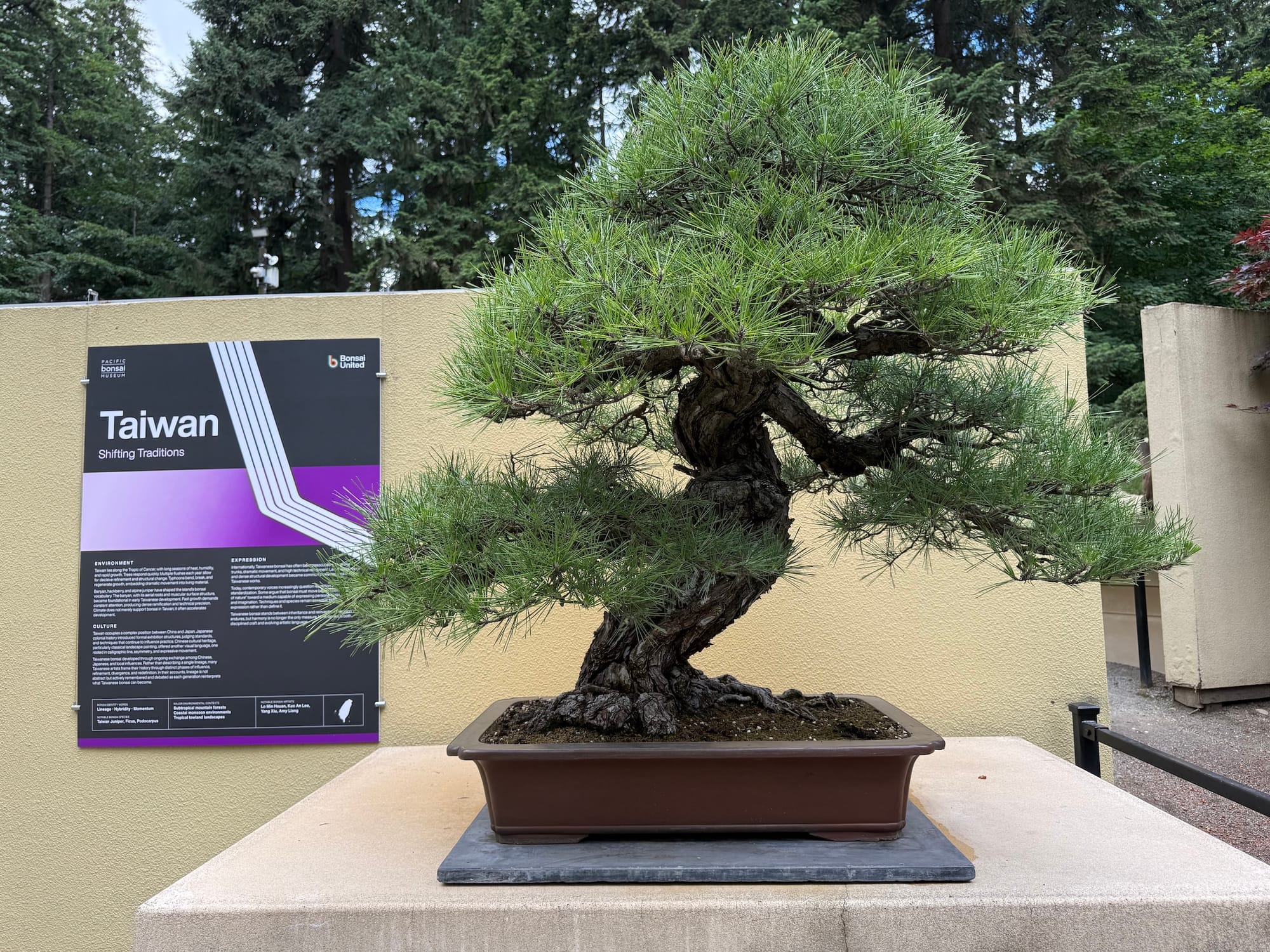
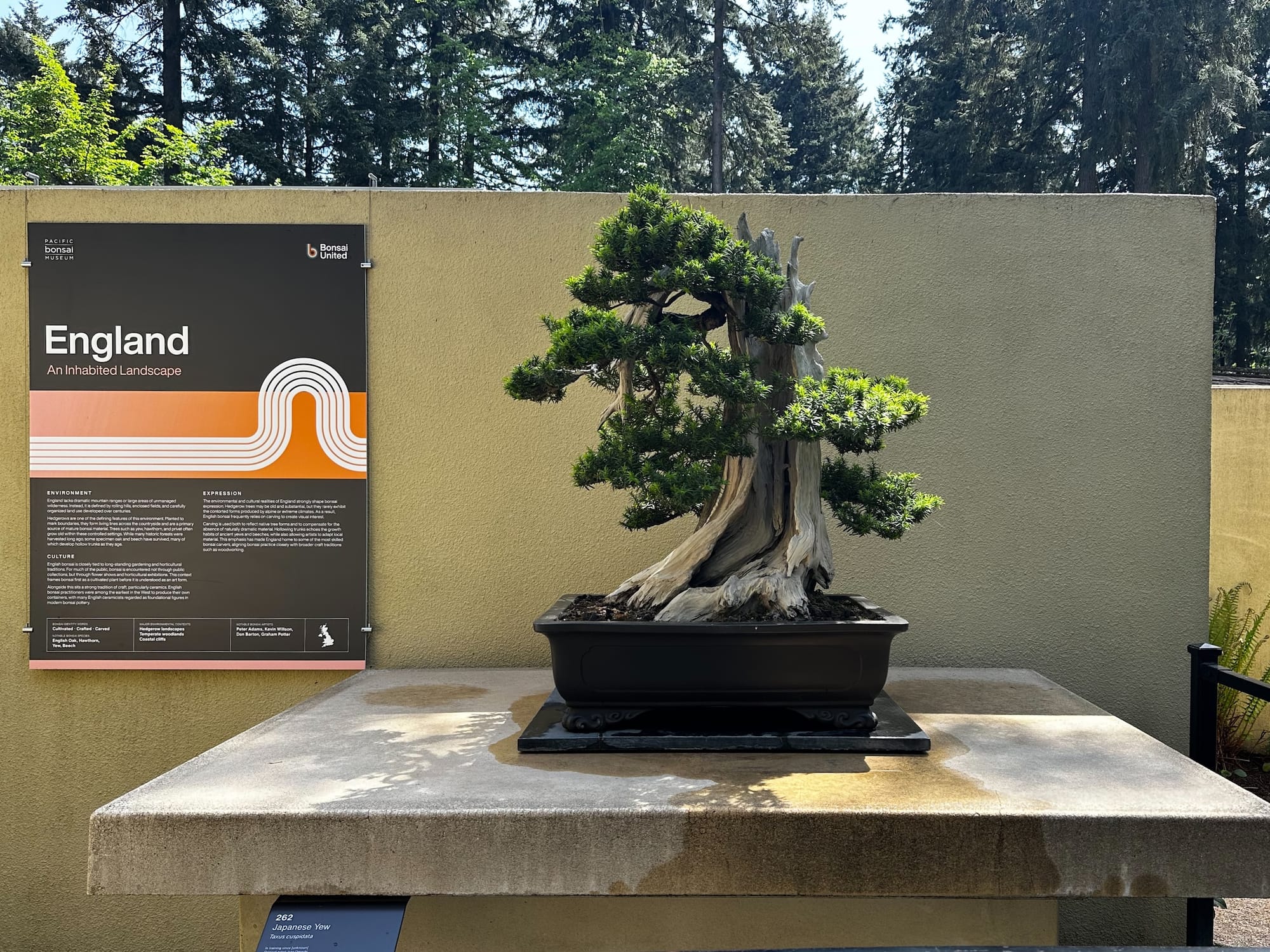
First, I love the varied stripe designs on the identifying posters. Did your team come up with that idea and if so, what is it based on?
We did. Since Bonsai United is loosely inspired by the World Cup, I looked at the visual language of the bold graphic design and color systems you see in soccer from the 1970s. The 1970 World Cup poster from Mexico was especially inspiring.
The stripes are meant to function almost like team jerseys. Each country has its own color palette and stripe arrangement, creating a visual identity for that section of the exhibition. The idea is that every country is participating in the same art form while expressing it in its own way.
In many ways, the graphics reinforce the central thesis of the exhibition: Bonsai is a shared global practice, but every culture brings something different to it.
In terms of the different bonsai techniques across the world, which stand out as unusual?
One of the biggest surprises was that the differences weren't always aesthetic. Going into the project, I expected to hear a lot about design styles and forms. Instead, many of the interviews ended up being conversations about values, community and cultural identity.
In Taiwan, for example, I was struck by how often people talked about lineage, family and learning bonsai from their fathers. There was a strong sense that bonsai knowledge is something inherited and passed between generations.
The French place a remarkable emphasis on training and academic structure, which ultimately led to a national accreditation system for bonsai instruction unlike anything I encountered elsewhere.
The Italians spoke about bonsai almost the way an architect or sculptor might discuss design. Composition, movement, proportion and artistic expression came up repeatedly.
The United States offered another interesting perspective. Many American artists talked about bonsai as a form of personal expression. While Japanese traditions remain deeply influential, there is generally more room for artists to pursue their own ideas and aesthetics. As a result, American bonsai today includes everything from highly traditional work to avant-garde and naturalistic approaches. In many ways, that openness reflects broader American values around individuality and self-expression.
What surprised me most was that artists around the world are often trying to answer the same questions — what makes a tree convincing, beautiful or meaningful — but their answers are shaped by the culture and environment around them.
Is there a signature or tell-tale sign of Pacific Northwest bonsai?
I think we’re still figuring that out, which is actually exciting.
If there is a Pacific Northwest character emerging, it probably comes from our landscape. We live among ancient conifer forests, rugged coastlines, and mountains shaped by weather. Not surprisingly, many of our bonsai reflect those same qualities.
You often see an emphasis on native species, weathered deadwood, irregular forms, and trees that feel like they’ve survived something. There tends to be less interest in perfection and more interest in authenticity.
A lot of that can be traced back to Dan Robinson, a bonsai artist in Bremerton, who encouraged people to look at actual trees in nature rather than simply reproducing established bonsai formulas.
If there is a Pacific Northwest style, I think it’s one that values trees that feel wild, resilient and rooted in place.
What do soccer and bonsai have in common?
More than you’d think. Soccer is played all over the world, but every country develops its own style. Brazil doesn’t play like Germany. Spain doesn’t play like England. They’re all participating in the same game, but culture shapes how that game is expressed. Bonsai works much the same way.
The techniques, tools and ideas move across borders, but once they arrive somewhere new they get adapted. Local species matter. Climate matters. History matters. Cultural values matter.
What I hope visitors take away from Bonsai United is that there isn’t a single way to do bonsai. There are many ways. The exhibition isn’t really about competition — it’s about recognizing how a shared passion can produce remarkably different expressions, and different solutions to the same problems, depending on where it takes root.
World Cup Pride
One more World Cup note: Seattle’s annual Pride celebration overlaps with the tournament this weekend, including the Pride Match on June 26, featuring Egypt vs. Iran.
The date was established long before it was known which teams would be playing that day, and there’s been some pushback from team officials (same-sex relationships are criminalized in both countries). While FIFA has made clear that “Pride Match” is the Seattle host committee’s descriptor (not FIFA’s), the organization confirmed that rainbow flags are allowed inside the stadium.
There will certainly be all manner of Pride flags outside the stadium and across the city, including at World Stunt, a Capitol Hill block party hosted by BeautyBoiz and Intiman Theatre (June 26); the Indigiqueer Festival at the Waterfront (June 27); Seattle PrideFest on Capitol Hill (June 27); and the Seattle Pride Parade (June 28).
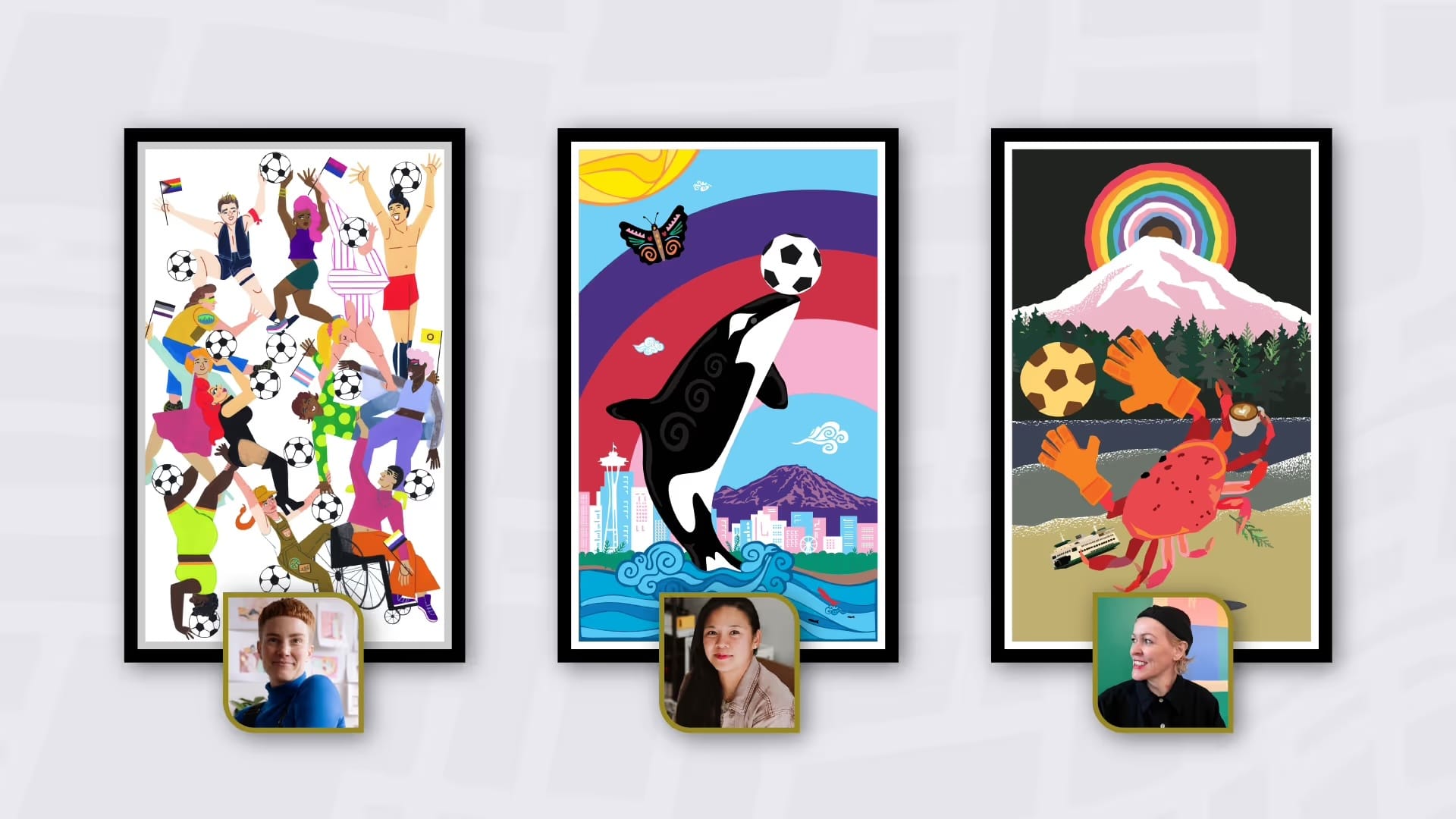
Among all the waving rainbows, watch for new World Cup Pride Match designs by three Northwest artists. Kelly Björk’s playful, active figures will adorn the matchday scarf; Shayla Hufana’s soccer-playing orca appears on the official Pride Match pins; and Sharon Blyth-Moss’s Mount Rainier (paired with a goalie-gloved Dungeness crab) adorns the Monorail corridor.
Happy Pride, rain or shine!
Check out Season 2 of our television show Art by Northwest, featuring in-depth interviews with the printmakers, painters, sculptors, wood carvers and photographers who are creating captivating work across Washington state. Nominated for two Northwest Regional Emmy Awards.
