
Do "you want to know how super-intelligent cyborgs might treat ordinary flesh-and-blood humans?" Yuval Noah Harari, who wrote the very popular Sapiens, asks in his book, Homo Deus. "Better start by investigating how humans treat their less intelligent animal cousins."
This is not exactly heartening. But if you're talking about our treatment of chimpanzees, then — at least in this and many other countries in which they're not eaten as bush meat — things are at least getting better. Look, for example, in the hills above Cle Elum, Washington.
Chimpanzees rush into a big caged room, scampering across the newly-bleached concrete floor, climbing the heavy wire of the enclosure, chasing each other around and hooting. Burrito, the lone male, displays by pushing an upright length of ribbed black plastic culvert around the room.
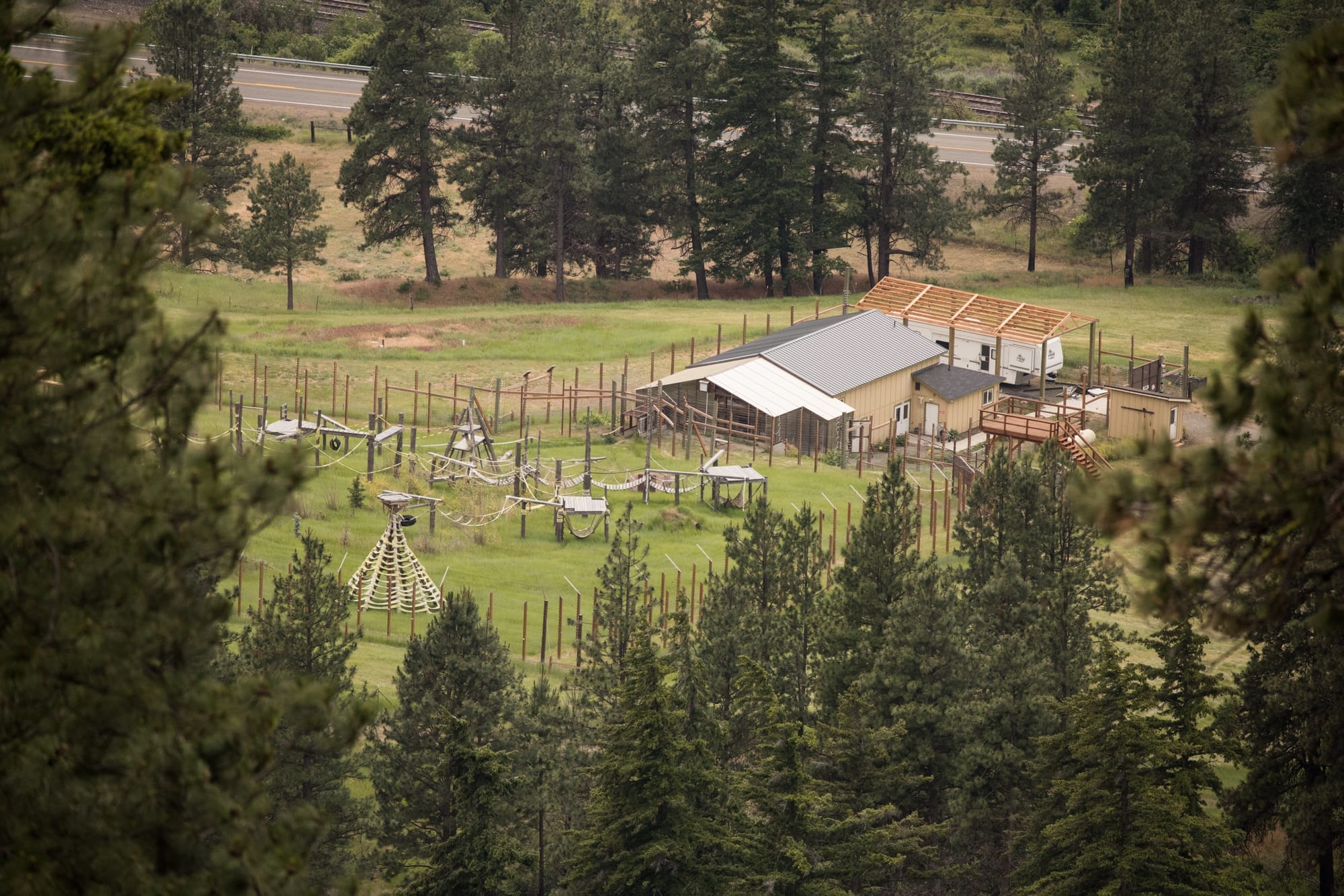
Burrito and his pals have started their active day at Chimpanzee Sanctuary Northwest, situated improbably out there in the Cle Elum hills. There are seven chimps. They have lived there for a decade. They’re all retired. Most worked in labs before they came here. One was an entertainer. The sanctuary’s co-directors, Diana Goodrich and J.B. Mulcahy, live in a house near the main building. An old, unpainted wooden barn stands nearby. No sign marks their driveway. They do not readily give out their location. They do not want the distraction of many visitors.
They don’t do this alone. Interns pitch in from their alma mater, Central Washington University — which once had the famous Washoe and other chimps that learned American Sign Language and still offers a major in primate behavior and ecology. The endless daily work gives them hands-on experience.
Behind the building, a tall wire double fence with more-than-sturdy posts and braces encloses a two-acre outdoor exercise yard that runs from the back door of a translucent “greenhouse” area up a grassy hill. It gets cold in Cle Elum. Chimps come originally from equatorial Africa. How do they fare in the Northwest weather? Just fine. "I call them Northwestern chimps," Goodrich says. They actually seem to like cool, cloudy days. They go out in virtually all weather, although when it's really cold, they don't stay out long.

Missy, 43, and Foxie, 42, at the chimpanzee sanctuary near Cle Elum, Washington, June 7, 2018. (Photo by Matt M. McKnight/Crosscut)
There's more than enough room for the chimps to go their separate ways, but Goodrich says they mostly don't do that. They prefer to hang out in groups. See four or five of them in a peaceful moment flopped on each other in a big chimp pile. (A lone cowboy boot stands nearby. It's Jamie's. She has a thing about shoes.) But not all activities are group activities. Goodrich says the night before, she worked really late because Jamie had stayed out long after the others were in bed. She herself had been there outside the fence (no one goes inside with the chimps) to keep Jamie company, and the chimp — which worked closely with people in her earlier life as an entertainer — clearly likes that.
The fence isn't just tall and sturdy. It's also electrified. And the sanctuary has backup generators to make sure that even if a storm or other event knocks out utility power, the fence wire will stay hot.
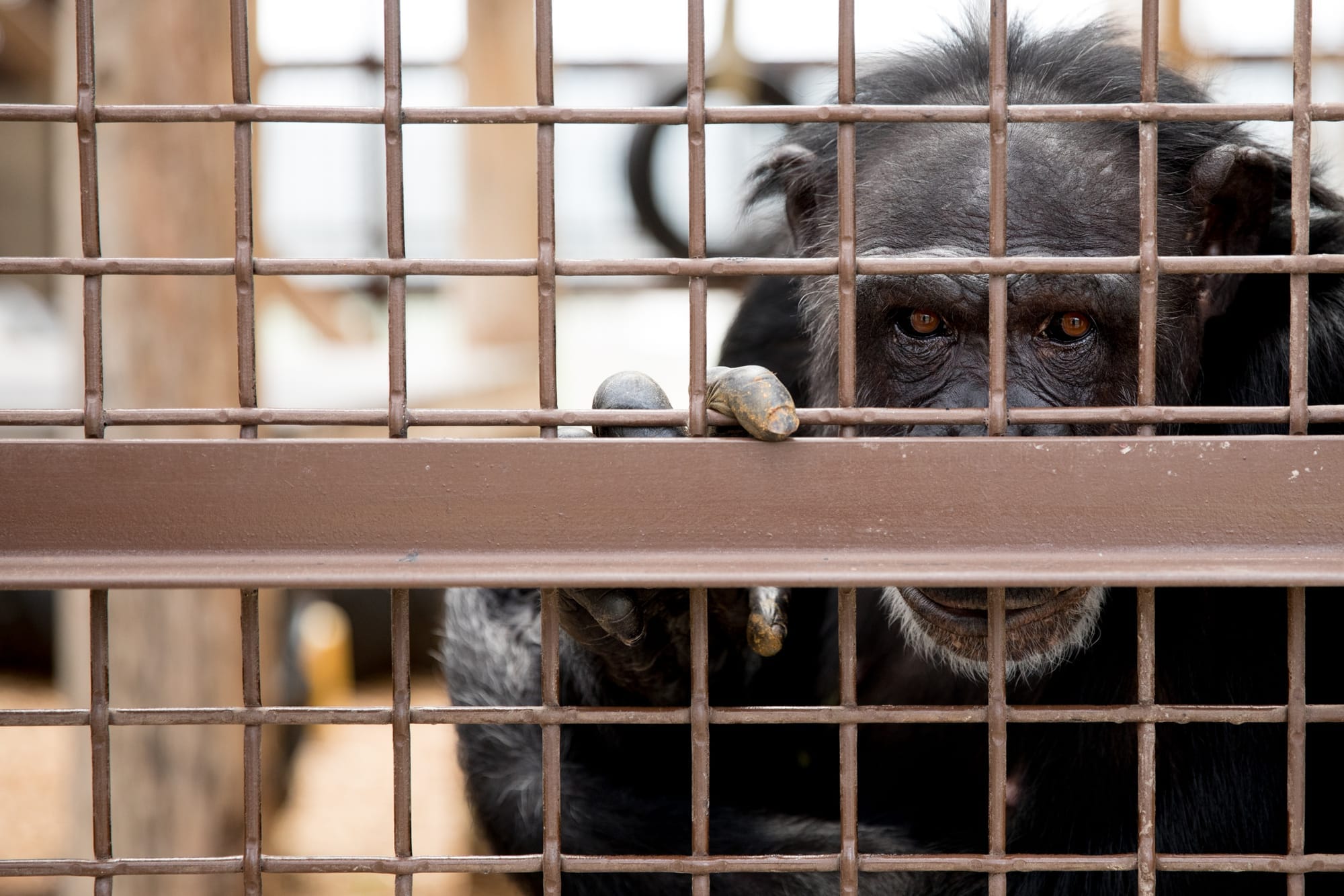
Inside, from the chimps' enclosure comes a sound like the breaking of rigid plastic. It's not plastic. A chimp named Foxy is cracking walnut shells. Whole ones. With her teeth. In the jungle, Goodrich explains, chimps encounter nuts with shells so thick their jaws can't crack them. So the chimps use tools: Put the nut on a natural anvil. Hit it with a rock. Take the meat. The chimps pass the technique down to younger generations. And different bands of chimps do it differently. (Research has found that a lone chimp entering a new troop adopts the new troop's technique — when in Rome — even if it's inferior to the technique she or he originally learned. Other research has shown, Goodrich says, that using the materials at hand, the chimps crack the nuts more efficiently than humans do.)
Research labs pumped up their chimp populations in the 1980s, when the AIDS epidemic was going full-blast, and they were scrambling to get a handle on the disease. But the chimps turned out to be useless for AIDS research. It was almost impossible to give them AIDS. So even before chimp research shut down, there was a surplus of them. The notion that as our closest non-human relatives, chimps would be uniquely valuable for medical research hasn't panned out, Goodrich explains. Kathleen Conlee, the Humane Society's vice president for animal research issues, says, "we call that the 'high-fidelity fallacy.'"
(This doesn't mean all the chimp research proved worthless. It may have been crucial in distinguishing Hepatitis C from Hepatitis B. "Obviously," Conlee says, "gains were made. Could it have been gained another way? We will never know.")
On the other hand, the idea that they're our closest living relatives may create a greater moral obligation to treat them well. When a National Research Council committee was deciding how to deal with lab chimps, Goodrich says, one member observed that if the subject were laboratory rats, they wouldn't be having this discussion.
Chimp research in the United States has pretty well been shut down by two developments: In 2015, the National Institutes of Health decided to abandon it. That same year, the U.S. Fish and Wildlife Service declared captive, as well as wild, chimps an endangered species. Before that, although wild chimps had been listed as endangered, the Fish and Wildlife Service had made an exception for chimps in labs. (The agency was evidently a little behind the times on chimps’ value in AIDS research.) Now, any chimp research would have to be justified on the grounds that it would benefit the species — the chimps', not ours.
Normally, when laboratory animals are no longer needed in a lab, they're euthanized. The National Research Council panel decided the nation's no-longer-needed chimps should not be killed. “That has not been decided for any other animal,” Conlee says. Instead, the panel said, retired chimps should be sent to sanctuaries. Panel members realized this entailed supporting them for decades. Those that had worked for the federal government would be supported largely at taxpayer expense. Congress decided to pay for a national sanctuary system in the so-called “Chimp Act” of 2000. Most of the former NIH chimps are currently housed at Chimp Haven in New Iberia, Louisiana. There is currently some debate about whether a group of older government chimps are too frail to be sent away and would therefore be better off living out their lives in laboratory cages. And clearly, chimps have not been leaving the labs as quickly as expected. Some critics assume that’s because labs get money to care for them.
The seven chimps who wound up in Cle Elum came from a private company in Pennsylvania that provided chimpanzees to labs. They receive no government support. Chimpanzee Sanctuary Northwest survives on private donations, some raised at an annual gala “hoot.” So far so good. In fact, the sanctuary is just starting on phase one of an expansion.
Goodrich and Mulcahy hope that once they've demonstrated progress and competence with phase one, they’ll be able to raise the larger sums needed for phase two. Then, they will be able to expand the chimps' basic living area, so they can accommodate more animals. They see the future chimps forming a whole new social group.
Long-term planning for a chimp sanctuary is tricky. Chimpanzees don't live forever. And there are no more in the pipeline. So eventually, a chimp sanctuary will have no function. Unless it takes in other primates. In the world of sanctuaries, this is currently a topic of discussion. The chimp sanctuary may eventually take in monkeys, too. There are maybe 2,500 chimpanzees in the country now. There are maybe 100,000 laboratory monkeys. "It's almost like we've got these cages built for monkeys so we've got to use them," Conlee says. If the monkeys have no place to go when they are no longer needed for specific research projects, they will be euthanized. Since there is no way anyone will create sanctuary space for that many animals, most of them will be.
The morality of all this is a bit sketchy. Monkeys aren't as close to us as chimps, but they're pretty close. And yet, researchers use an awful lot of them. In Germany, a Max Planck Society neuroscientist has received death threats, abandoned primate research, and now faces criminal prosecution over alleged mistreatment of laboratory monkeys.
Even before new buildings take shape, Chimpanzee Sanctuary Northwest's footprint has already grown. It has acquired three adjacent properties, which has taken it from 26 acres to 90 and given it buffers on all sides. Goodrich and Mulcahy won’t have to deal neighbors that don't like the sound of chimps hooting. They’ll face no conflicts over water. They’ll have space for rescued farm animals to graze. They can build an education center. Goodrich says that with the extra land, the sanctuary could expand its outdoor exercise yard up the hill and into the trees. There, chimps would actually be able to climb. But a lot of trees would have to come down. Otherwise, chimps might be able to use them as launching pads for leaps over the electric fence.
Now that the sanctuary has more space, Goodrich says, it would be nice to extend the outdoor play area up the hill and into the trees. Chimps could actually climb there. But a lot of the trees would have to come down. Otherwise, chimps might figure out how to swing from a tree out over the electric fence.

Phase one will create more room for people, too. Current work space is both cramped and, in the case of the veterinary office, which resides in an old trailer, pretty funky. The work area in which people cut up fruits and vegetables for the chimps to eat and wash their dirty laundry doesn't give workers much space. The phase one expansion will include a new, permanent veterinary office with room to store some of the stuff now crammed into the work space, and a new holding area, in which new chimps could be introduced to the sanctuary and could be quarantined. In the new veterinary space, it will be a lot easier to keep things sterile.
(Permitting has proven a bit trickier than Goodrich and Mulcahy had envisioned. To meet code, they discovered, they would have to create a new driveway, wider and less steep than the old one, so that trucks can get up it to fight wildfires. This is wildfire country. The 2012 Taylor Bridge blaze came so close It charred the grass in the outdoor exercise area. Goodrich and Mulcahy thought they were going to lose their house. But the chimps weren't going anywhere. The main building is fire-resistant, and the strategy was and will in the future be to shelter in place. Goodrich says there's no way to get the chimps out on short notice, anyway. But the sanctuary isn't just trusting to luck. It has installed sprinklers on fence posts near the building and supplies them with water from a nearby pond that can be pumped with power from a standby generator.)
Health care will only grow more important. Chimps live a long time. But like the rest of us, as they tend to accumulate ailments. Goodrich says the Cle Elum seven will probably have to contend with arthritis, and maybe heart problems; they're common among male chimps, and Burrito already has congestive heart failure, for which he takes daily medication.
Ideally, she says, Burrito would just present his chest to the openings in the cage wire so a vet could do an ultrasound without sedating him and taking him out of the building. Maybe that will happen. She says other chimps are already learning to present various body parts so humans outside the cage can do blood draws and other small procedures. If a chimp isn't sure what part is wanted, it will simply use trial and error until it comes up with the right one. But that isn't always necessary. Sometimes, you can just tell them what you want. "They understand a lot of English," she says.