
Ebo Barton was chatting with a friend outside Hollow Earth Radio in the Central District when they were taken aback.
“All of a sudden this Crossfit group comes running by,” Barton said. “The Central District is, one, historically black, and two, traditionally not where folks go to do fitness. To all of a sudden see this parade of people coming through, exercising with smiling faces, it kind of hit a chord — this isn’t art space anymore.”
By “art space,” Barton means a place that is friendly — and affordable — to art and artists, a place that fosters creativity and nurtures a creative community. Seattle’s development boom and its accompanying influx of more affluent residents have led to a steady decline in such spaces.
Barton had seen it all before. After getting out of the Navy, the 32-year-old spoken-word artist started looking around for a place to perform, and ended up at Seattle Poetry Slam. That was back in 2006, when the slam’s home was in Lower Queen Anne at the Mirabeau Room. That venue closed, so the group moved to ToST Lounge in Fremont, but it closed too. The group held events at Spitfire in Belltown before finding a home at Capitol Hill’s Re-Bar about five years ago.
“All those places that closed, not surprisingly, are in neighborhoods that have been gentrified,” Barton said.

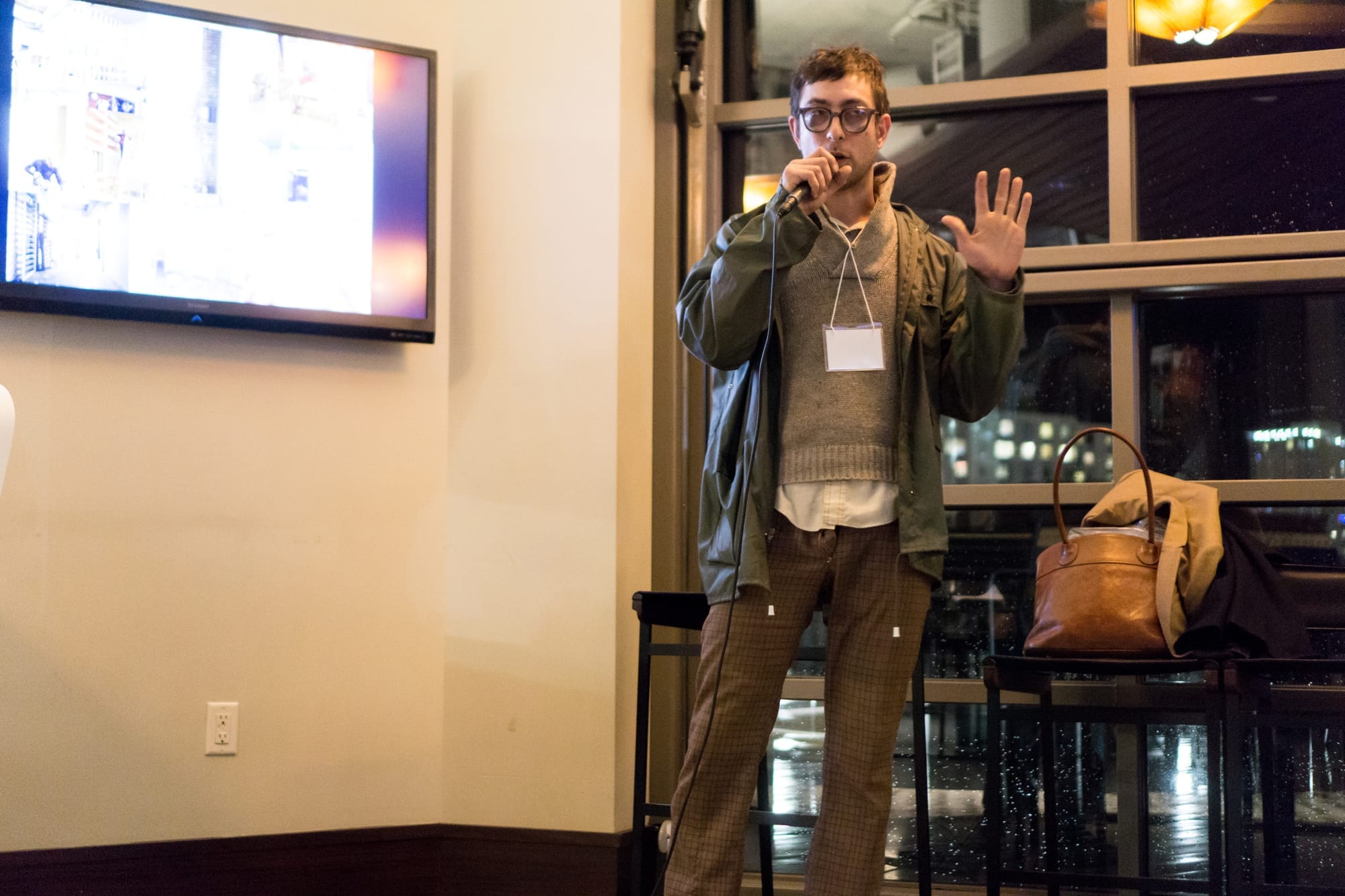
Ela Barton performs the poem “Open for Business” at the Crosscut Arts Salon. Photo by Paul Henry Moore
Barton was one of seven artists who spoke or presented their work at a Crosscut Art Salon in early December that addressed the challenge of preserving art space in our fast-changing city. It was curated by Elisa Law, who has been active in the Seattle arts community for a number of years through various roles at the Henry Art Gallery, the Burke Museum and METHOD Gallery.
The salon, funded by the Paul G. Allen Family Foundation and co-sponsored by Tom Douglas Restaurants, was right in the heart of all the development, in the Via 6 Apartments in South Lake Union. The venue, a 7th floor lounge with floor-to-ceiling views of the glimmering cityscape rising north of downtown, was ritzy and slightly bizarre, but it inspired a provocative discussion among artists who are being pushed out of neighborhoods like this, one who lives right in the building, and a crowd of roughly 50 participants.
“There is an economic and cultural ecosystem that exists, and down at what we call the bottom is something that is not commoditized,” said sculptor, painter and filmmaker Timothy Firth. “It’s like raw, constructive, wild talent, desire — it’s this algae that exists and it only gets to thrive in an environment it has a place to live in. You take away every single affordable workspace, all affordable housing, all the potential of owning a business — take all of that away and that algae drifts off to Renton.”
--
Seattle artist and entrepreneur Greg Lundgren kicked off the evening with a description of South Lake Union in the mid-’90s, when it was still a run-down industrial neighborhood. “To look at South Lake Union in the ’90s romantically was a bit of a stretch,” he said. “There was a lot of prostitution and drug dealing. There wasn’t anything precious about it, but it was a time where it had the capacity to be anything.”
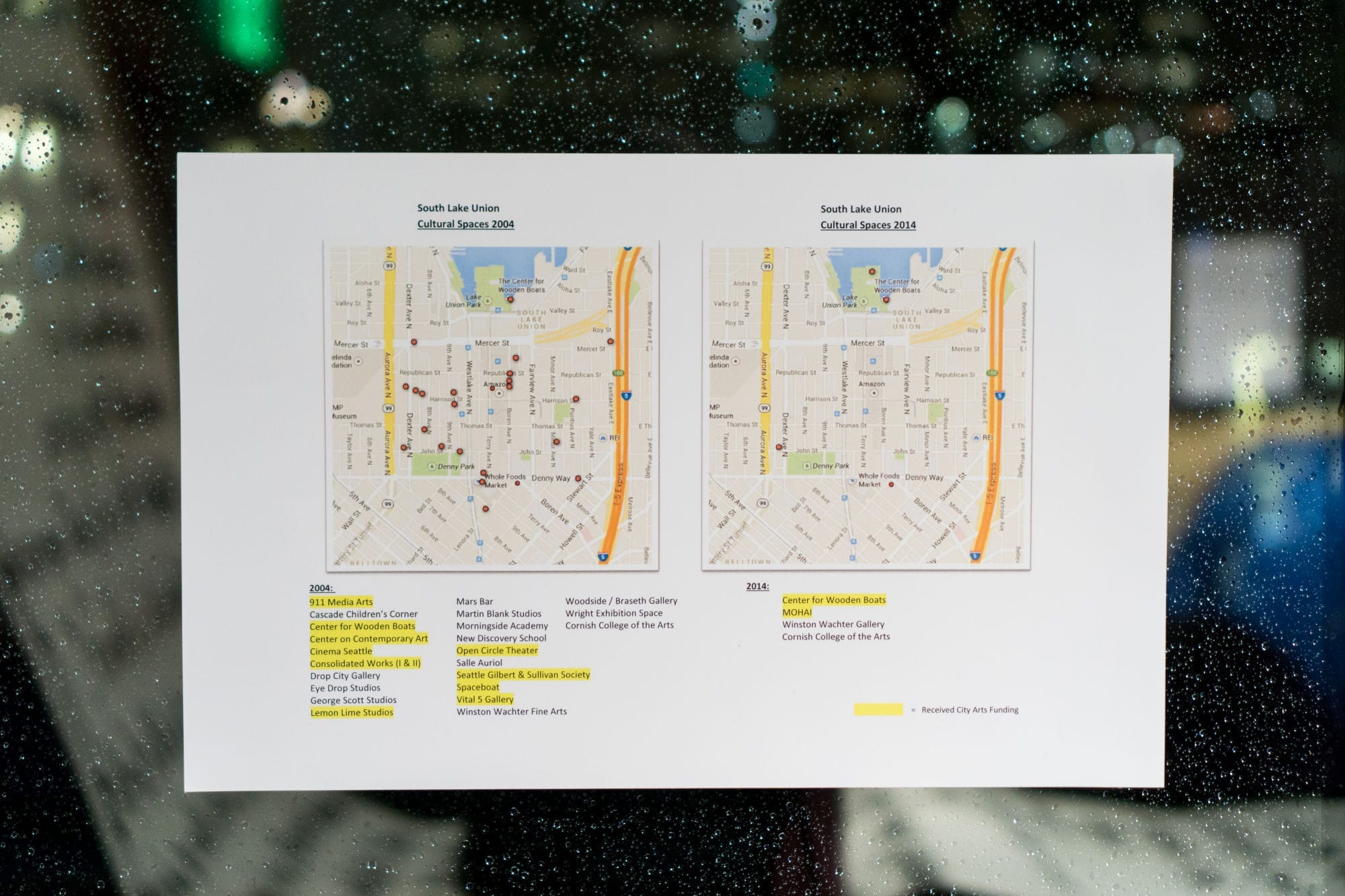
Among other things, the neighborhood was a vibrant hub for arts and culture. Lundgren ran a gallery called Vital 5 in a gorgeous 1961 mid-century modern showroom built for the World’s Fair on the corner of Westlake and Denny. Down the street was Consolidated Works, a contemporary arts center located in two warehouses. Grassroots organization 911 Media Arts Center had a spot near where REI’s flagship store now stands on Yale Avenue.
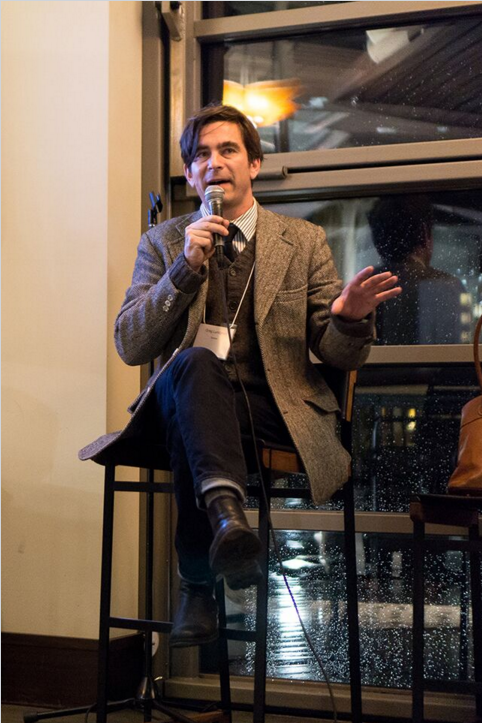
911’s former executive director, Fidelma McGinn, spoke after Lundgren about the nonprofit’s experience in South Lake Union during the early ‘90s and late 2
000s.
“[The building] had been a car dealership at one point and had five fabulous front-facing windows,” McGinn said. “We were in no-man’s land at that point and wanted to draw attention, so in those shop-front windows, we commissioned artists to create installations and video projects with audio playing outside.”
These days, of course, South Lake Union is being transformed. Walking through the neighborhood is like navigating a maze — dodging closed sidewalks, construction equipment and trucks that rule the roads. A forest of decorated construction cranes dominates the skyline.
As the new buildings have gone up, the artists and art spaces have had to move out.
Lundgren received a Stranger Genius Award for his Vital 5 Productions Gallery. The alt-weekly boasted that the “gallery/theater/social experiment put the life back into Seattle’s art scene.” But just as soon as it had come, it was gone. In 2002, Lundgren received a notice from the landlord — Vulcan Real Estate, Microsoft co-founder Paul Allen’s development company — that it was time to go. Today, a Whole Foods store stands in its place.
Matthew Richter, cultural space liaison at the Seattle Office of Arts and Culture, counted 21 cultural spaces in South Lake Union in 2004, when he served as executive director of Consolidated Works, a studio/ gallery/ concert venue in the neighborhood. Today, we counted about eight.
--
Vulcan made noises about nurturing art space when it began rebuilding South Lake Union in the late 1990s. While a proposal to create a large centralized urban park called the Seattle Commons fell through, the development company tried working with artists to keep them around in the new neighborhood design.
That didn't last long, though. Alfred Harris was one of a handful of artists who worked in the Lemon Lime Studios on Yale Avenue in South Lake Union. Lemon Lime not only produced the work of some of Seattle’s most well-known artists, but was also famous for hosting informal spaghetti dinners for visiting artists and performers, including art critic Dave Hickey.
“It was a place for people to meet and say, ‘Oh, I’ve seen your work,’” Harris said at the salon.
However, it all came to an end in 2012, when Vulcan leveled the building to make way for the Stack House Apartments. The group dispersed and Harris moved his studio around to temporary spaces provided by Vulcan. While he was grateful for the places to work, that chapter, too, soon came to a close.
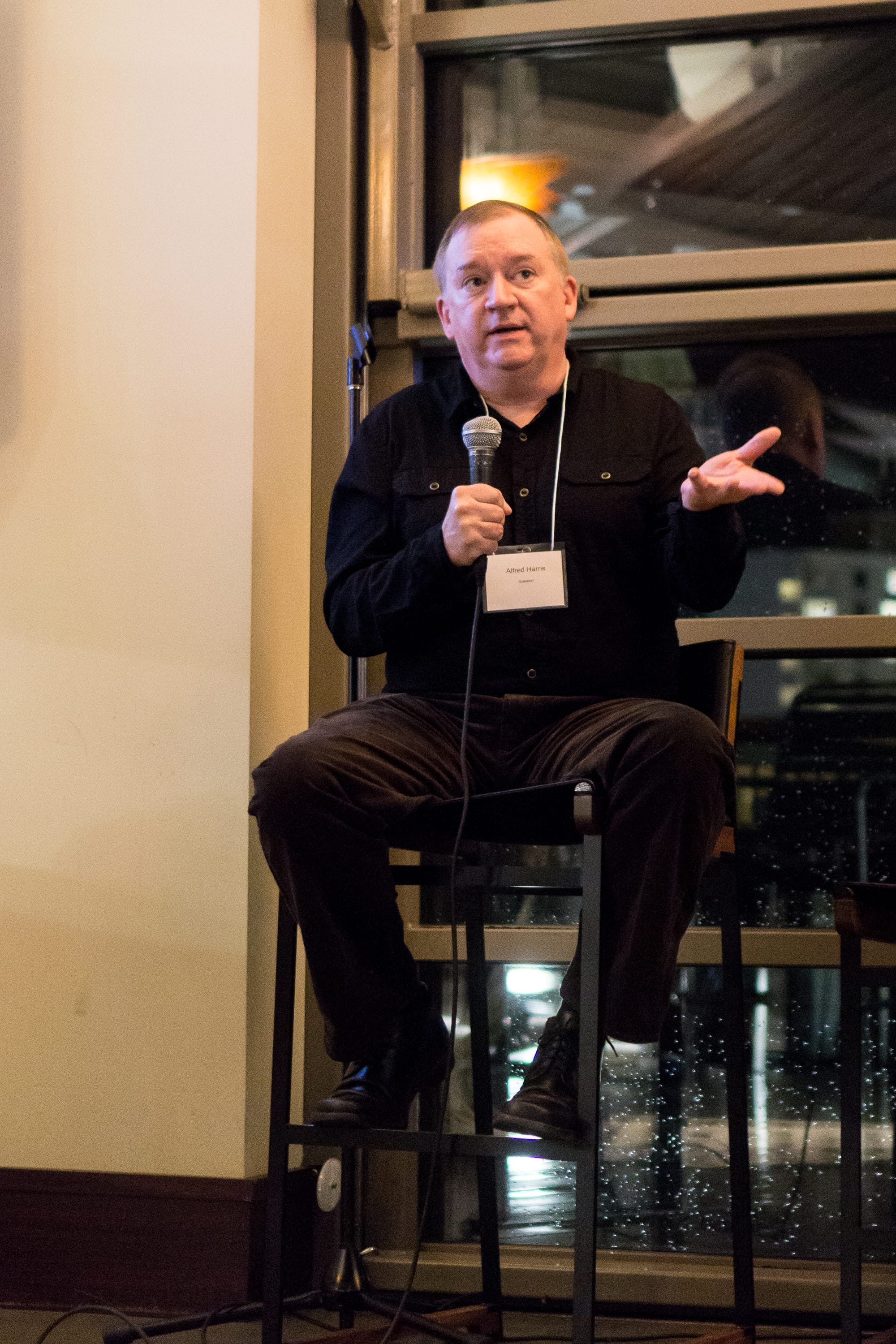
“Over the years, they’ve pretty much sent everyone who was a creative person, organization, anybody, running for the hills,” Harris said of Vulcan.
Alexa Rudin, senior director of corporate communications at Vulcan, says the real-estate company’s philosophy was to give temporary space as a boost to artists while the neighborhood transitioned.
“The idea was that when that neighborhood had time to evolve, there would be different ways for art to be featured,” she said. “It was never intended to be in perpetuity. They were temporary spaces for a reason, they weren’t permanent locations.”
It’s worth noting that in his lifetime, Paul Allen has given over $1 billion to arts, culture, education and science organizations, and $230 million in King County specifically. But while Vulcan offers regular funding to many arts organizations and has offered reduced rent to artists, it has never built studio space or artist housing in any of its developments.
“That is the kind of organization we would look at funding for a grant, but I can’t think of anyone right now we are currently doing that with,” Rudin said. “It doesn’t mean we wouldn’t look at doing it in the future.”
Harris envisions developers working with artists to find more places like the ones he once used -- spaces that are sitting vacant, waiting for the permits and financing necessary for redevelopment. The only issue is it’s difficult for an artist to contact a building owner and ask if it can be used as a place for artists.
Harris’s solution? A group, whether it is the non-profit art organization Artist Trust or a real estate brokerage, that helps artists seek out these unused buildings.
“I think there are a lot of spaces in Seattle where we need to be able to contact the building owner and say, “If this is going to be empty for x number of years, then consider having it available as a place for artists at very cheap rent,” Harris said.
--
As it happens, the idea of artists temporarily occupying vacant space in the city is already taking off.
Back in August, Paul Allen presented the Seattle Art Fair at CenturyLink Field, which featured 13 Seattle galleries placed among 21 galleries from around the world. When Greg Lundgren heard it was coming, he assembled a group of local artists and curators who knew they wouldn’t be included. They presented a show called Out of Sight just a short distance away from CenturyLink on the third floor of King Street Station. Out of Sight presented the work of over 100 visual artists — from Jason Puccinelli’s interactive sculpture to an installation by Portland-based artist Damien Gilley that included thousands of strands of hanging, hand-painted pink string.
Lundgren was able to use the space because no one had rented it yet. He has the lease until the end of December, and he thinks the city will hold onto it as a culture space.
While Lundgren champions using temporary spaces this way — he says Out of Sight will be even bigger this year — he thinks developers ought to build in space for artists long-term because it ultimately makes their property more valuable.
“There is this attitude that artists are good for occupying the space between buying a building and finding a new tenant for a project,” Lundgren said at the salon. “It’s very shortsighted. When developers allow artists and art spaces into a new construction, or preserve old spaces, it isn’t an act of philanthropy, it is actually just very good business.”
A draft report from the Seattle Office of Arts and Culture, the final version of which is due out later this year, says that many cities have successfully turned to arts and culture for economic revitalization. It points to research by the nonprofit Americans for the Arts that found as an economic sector, arts and culture generates nearly $450 million annually in Seattle.
The draft report found that areas with cultural space have higher Walkscores, higher rents, and in many cases, are associated with steep increases in property value.
“We can protest, look at politicians, and beg and plead for money to do things we want to do,” Lundgren said, “but I think it’s more valuable to convince [developers] that it actually makes their investment and the rest of the project more solid in the long term, rather than in the short term.”
--
Timothy Firth has come up with another solution to Seattle’s diminishing art space. He founded Common Area Maintenance (CAM), a new community gallery that offers affordable workspace and direct community access to art.
Firth originally had a space in an International District warehouse, but he woke up one morning and there was a for-sale sign in front of the building. “I was like, once again, this city is f*cked,” he said at the salon. That’s when the idea for CAM was born.
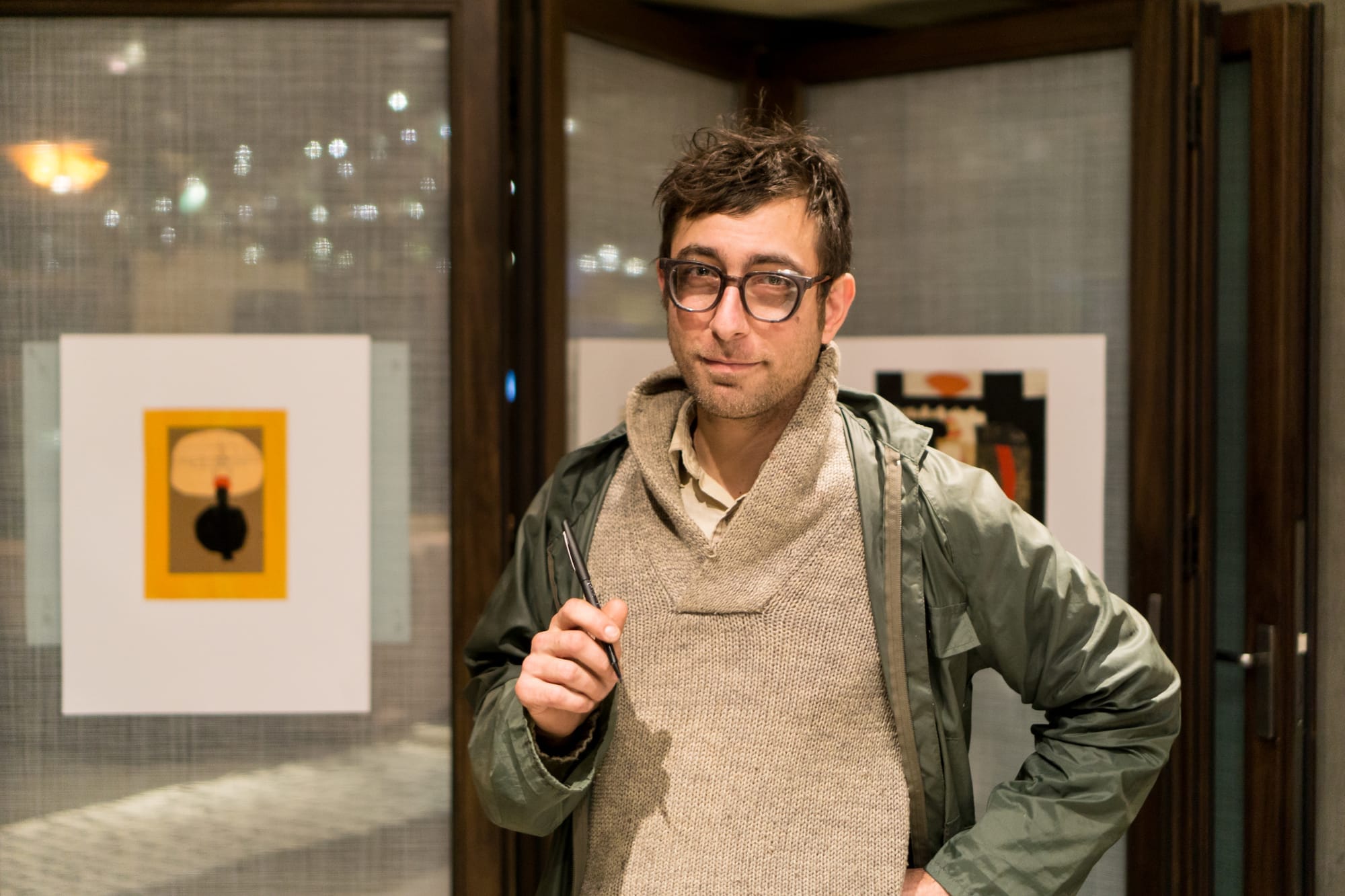
It kicked off a long journey of Firth making calls, talking to capitalists and Seattle’s art community to find commercial space. Finally, after six months, he found a storefront in Belltown. He wrote an email, made phone calls and eventually the owners said they wanted to support art and agreed to move forward. After a successful Indiegogo campaign, the appliance-repair-shop-turned-gallery opened on Oct. 1.
The 3,000-square-foot gallery sits at the bottom of the Rivoli Building and has two large storefront windows where art is often displayed. When entering, you’re greeted with a gallery, some work tables, a reference library and several artist workspaces.
“Almost every week, people are coming to me and saying ‘How did you do that?’” Firth said. “People are being activated. They are realizing their community is being threatened and displaced.”
Firth said artists want to do something about it, but they don’t know where to start. “There are these deep black holes that people who are active and want to create space, don’t know how to bypass. ‘Arts and Culture? Cool. DPD? What’s that? (It’s the Department of Planning and Development.) What architect do I talk to?’ People are desperate to have that information.”
Firth does what he can to point these people in the right direction, but what if there was a phone app or group dedicated to laying out the steps for interested artists and then connecting them with interested developers? This fits back into Harris’s idea of a nonprofit like Artist Trust connecting artists with unused space at affordable rates.
The most similar solution right now is through an organization called Shunpike. The nonprofit activates empty storefronts in neighborhoods with vanishing art space by displaying artist’s work. Vulcan provided funding for Shunpike to expand its program from the International District to South Lake Union, where eight local artists are currently on display.
The website Spacefinder Seattle serves the art community too, posting art space and studios as they become available. Richter also says the Office of Arts and Culture is tasked with connecting artists with space. However, he says there isn’t anything yet that directly connects developers with artists to find vacant, cheap space.
“If that pathway was more solidified, if there was a pathway that could be navigated, I think you’d find a plethora of people who want to take that chance,” said Firth. “Some people don’t take the chance because they don’t feel empowered to do so.”
Artist Cathy McClure
Cathy McClure is a metalsmith who works in sterling silver, bronze and steel, but also explores other media such as music, zoetropes and video. There is humor and charm in her mechanical toys and exploration of the discrepancy between an imagined techno-future and the future we inhabit. She has exhibited at the Yerba Buena Center for the Arts, the Milton Hershey School Museum and Art Miami Basel.
“Change is inevitable. All great cities experience change...whether it be New York, Paris or Seattle. With change comes loss AND opportunity. It’s important for everyone to recognize the value of arts and culture when growth happens and to prioritize that creativity. Seattle is one of the fastest growing cities in the U.S largely based on its creative core. As an artist living and working at Via6, I nurture relationships with business owners, friends, neighbors, community leaders, peers and new Seattle transplants who may or may not realize the importance of the arts. Rather than bemoaning change, I strive to be proactive and positive within our ever shifting landscape. I’ve found a space to work at Via6 while simultaneously giving other creatives — chefs, musicians, engineers, performance artists, vintners, visual artists, designers and others a platform. That is one of my jobs as an artist — finding ways to connect others within our creative city.” — Cathy McClure
MadArt's Tim Detweiler
In the heart of the Amazon territory in South Lake Union is a studio called MadArt, a mission-driven, for-profit organization that funds large-scale art works and provides a publicly visible studio for artists working on large-scale projects and sculptural work. MadArt’s Director Tim Detweiler joined us virtually at the Arts Salon. He discusses how art can connect audiences, and the importance of artists finding — and keeping — space in a changing Seattle.
Path with Art student Aaron Hill
“As a homeless man and an artist, I know the harsh realities of housing in Seattle. No one seems to care about those on the streets. Sure, there’s plenty of food. Housing, however, is in short supply, at least the affordable kind. I was on a list just to get on a waitlist for housing. It’s sad and ridiculous. So I sleep in parks and under bridges -- wherever I can. I cross my fingers every night hoping I won’t be hassled or harassed -- by the cops or worse. I take free art classes via Path with Art to keep my sanity. I have a regular job, too, but can’t afford rent. And I am only one of many similar stories. Such is the state of the city.” — Aaron Hill
This story is part of a three-year initiative, funded by the Paul G. Allen Family Foundation, to elevate coverage of the arts in the Northwest. In 2016, Crosscut will curate two more Civic Arts Salons featuring artists who develop visual, film, or performance art that explores race and diversity (spring) and the nexus of arts and tech (fall). To be notified of these events, sign up for our daily newsletter here.
Correction: This story has been updated to reflect that Paul Allen has given over $1 billion to arts, culture, education and science, not just arts and culture.