


In a different era, we’d all be glued to our televisions, watching a rocket full of astronauts make their farthest journey into space. But in this timeline, the historic moon mission is barely above the fold — pushed out by the constant stream of deeply alarming news and war mongering on our home planet.
You’re reading Art x NW, a weekly arts and culture newsletter from Cascade PBS. Read past issues and subscribe for more.
This arts newsletter is essentially about the many ways humans express, translate and create culture, so before the intrepid crew of Artemis II splashes down in Pacific waters tomorrow evening, let’s pause to look up (way up) and consider the culture the astronauts have already established inside their cramped quarters.
The four explorers recently made clear their space-food preferences, choosing maple syrup over Nutella (a jar of the latter was seen floating balletically, but unopened, through the cabin at one point). Each astronaut also contributed personally selected “wake-up songs” for the journey — check out the playlist — from Queen/David Bowie’s “Under Pressure” to Charley Crockett’s “Lonesome Drifter.” (Perhaps “Rocket Man” seemed a little too on the nose?)
And then there’s the photography, bringing us mind-blowing views of the dark side of the moon, as well as the “Earthset” — our planet as seen dipping below the rocky lunar surface. This new, extremely high-res image echoes the iconic “Earthrise” photo taken during the 1968 Apollo mission. The earlier image was celebrated for its eye-opening look at an earth without national borders, and credited for helping to start the environmental movement. What might this one do?
The Artemis lunar flyby is also contributing to a cultural aspect NASA scientists say is invaluable: describing what they see not just in scientific terms, but in plain language and metaphors we can all visualize.
Observing one of the moon’s newer craters, mission specialist Christina Koch noted, “What it really looks like is like a lampshade with tiny pinprick holes and the light shining through.” Mission pilot Victor Glover described another crater basin by saying, “If this was the Earth, I would say there was snow dumped on some of the ridges.”
But as previous astronauts have learned, sometimes language fails. “It is absolutely spectacular, surreal,” said mission commander Reid Wiseman, upon seeing a solar eclipse from space. “There are no adjectives. I’m going to need to invent some new ones to describe what we’re looking at outside this window.”
As a similarly speechless Dr. Ellie Arroway (Jodie Foster) says in the Carl Sagan-inspired space movie Contact, “They should’ve sent a poet.” Maybe some day they’ll send a visual artist into deep space too. But even without making the 252,756-mile trip, artists have been imagining the surface and content of the moon forever.
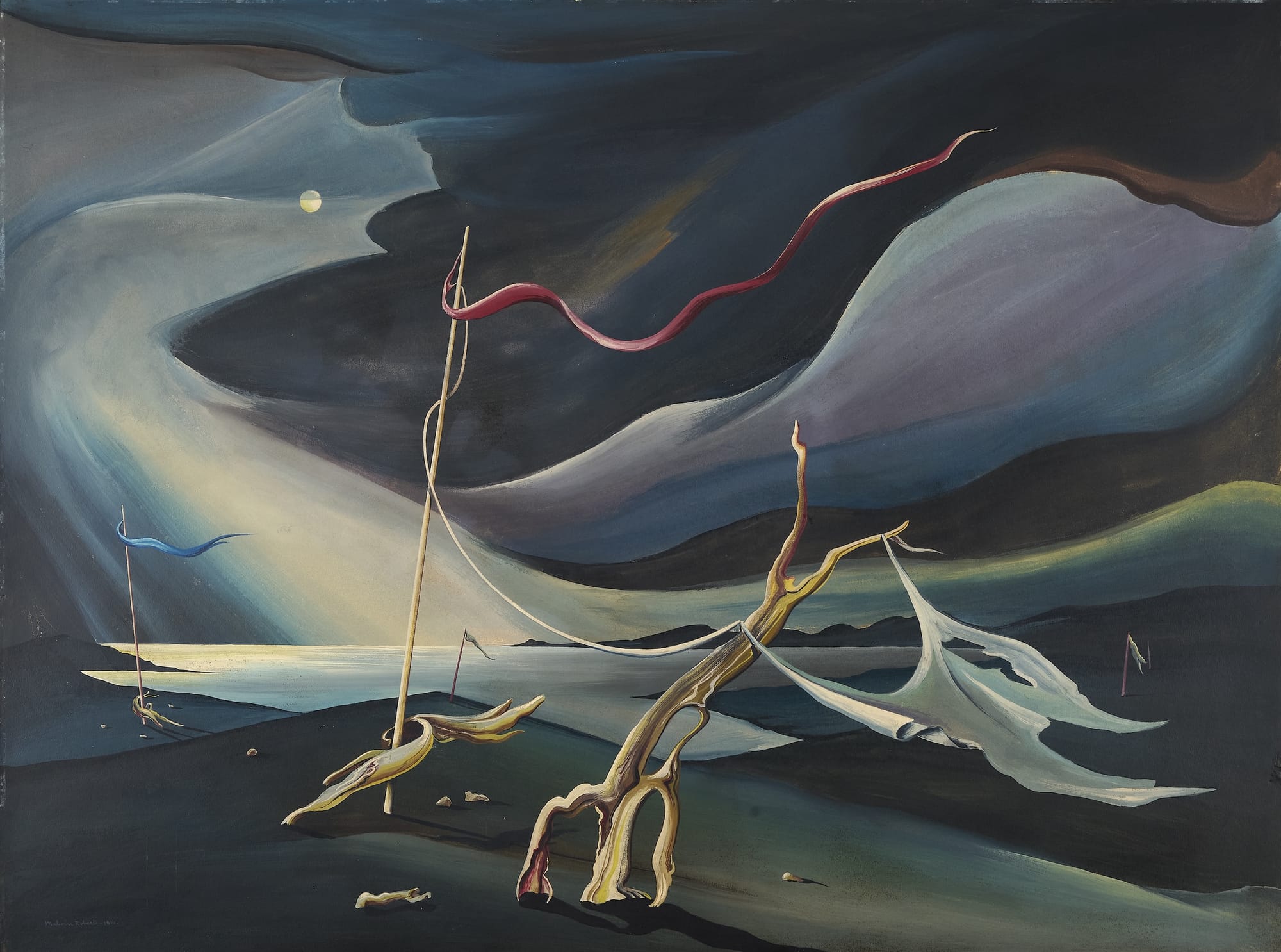
Take for example Malcolm M. Roberts, considered Seattle’s first Surrealist painter. He painted his “Lunar Landscape” in 1941, using tempera on cardboard. In his take, the desolate black and gray expanse is spiked with curiously ribboned poles — maybe the ragged and abandoned flags of nations attempting to stake their claim? Also visible: organic forms that look a lot like driftwood washed up on Northwest beaches, and in the distance, a glowing orb that might be the sun or a prophetic vision of Earthrise.
This striking painting is one of more than 150 on view in the new show Beyond Mysticism: The Modern Northwest, at Seattle Art Museum (through Aug. 2). Roberts is one of the many local artists whose body of work is lesser known than that of the Northwest Mystics (Mark Tobey, Kenneth Callahan, Guy Anderson and Morris Graves), who were his contemporaries. The expansive show includes works by the “Big Four,” too, but puts their work in the context of a thriving artistic scene that held all styles of visual art.
I was pleased to make the acquaintance with Roberts’ work, and experience it among abstract color stories by Paul Horiuchi and George Tsutakawa, Northwest city scenes by Kamekichi Tokita and a treasure trove of paintings by Z. Vanessa Helder, whose stunning watercolors of the Coulee Dam construction are simultaneously precise and otherworldly. Her gorgeous “Pool Over Kettle Falls” is especially evocative, its slabs of gray rock and reflective water looking both familiar yet extraterrestrial.
To delve further into the Northwest Modernist era of artmaking, head immediately to Cascadia Art Museum in Edmonds, where I first learned about Helder and other lesser-known local artists from this era. The museum (and curator David Martin) embraces the mission of showcasing unsung regional artists who made work from 1860-1970.
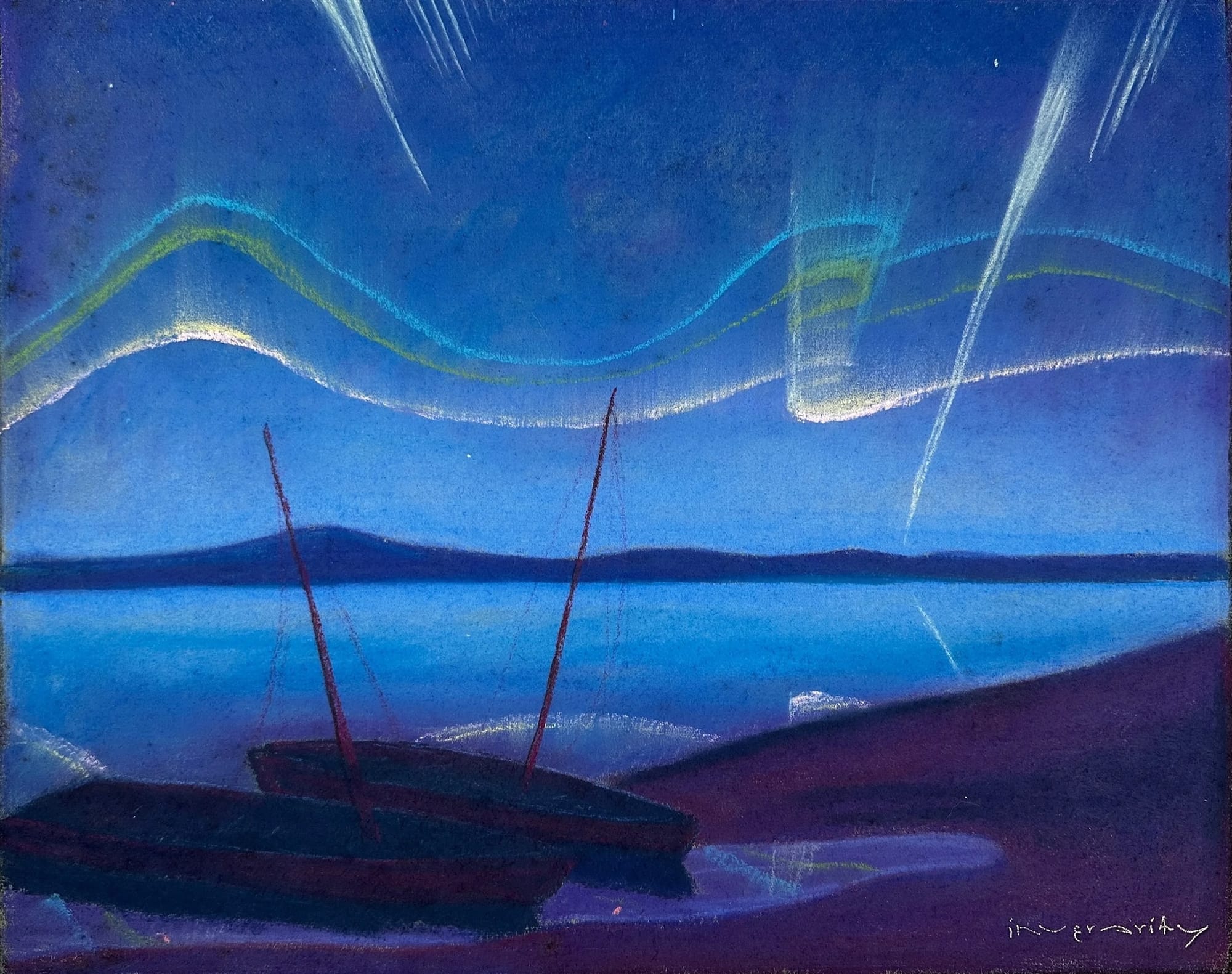
Newly on view (through June 7) is a fascinating retrospective of Northwest Modernist Robert Bruce Inverarity (1909-1999), a prolific Seattle artist whose work spans etchings, paintings, pastels, woodblock prints and elaborate puppets.
A graduate of Garfield High School and Cornish College, Inverarity went on to work as a puppetry instructor (!) in the University of Washington’s drama department; studied and documented Coast Salish art, especially of the Haida Gwaii region; and in the late 1930s served as the Washington State Director of the Federal Arts Project, a position that allowed him to secure funding for many Northwest modern artists of the time. During World War II, Inverarity was the U.S. Navy's Chief of Design for Camouflage.
His artistic life is quite a story. And since I’ve got a serious case of moon-brain right now, I was particularly drawn to several of his pastel and woodblock landscapes — a mysterious waterside view lit with aurora borealis; a black cloud nearly obliterating the sun over dark mountains — that seem to accentuate the Earth as a planet to be studied, and considered from a new perspective.
A few more moony moments before splashdown…
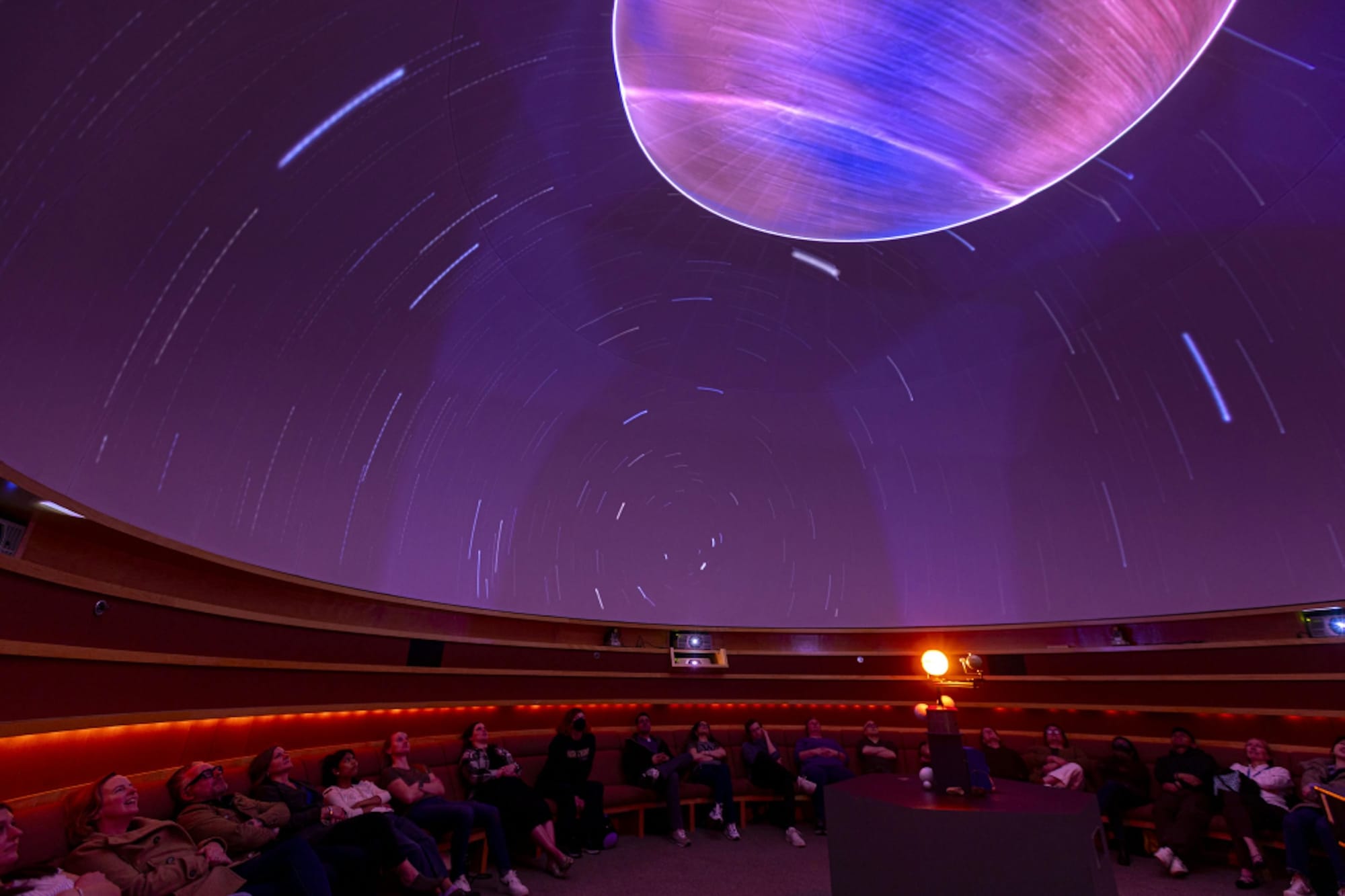
< The University of Washington Planetarium (in the Physics and Astronomy Auditorium) boasts an 8-million-pixel display inside a 30-foot projection dome, where a second-Friday edition of its hugely popular First Friday public shows is happening this weekend (April 10 at 5, 6, 7 and 8 p.m.). These astronomer-led tours of the universe sell out at the speed of light, so hop on the waiting list or save a seat for next month.
< Also this weekend, the Museum of Flight is holding its annual space party, well-timed with the planned return of Artemis II. Yuri’s Night (April 11; 21+) kicks off with a special talk by Dr. Stephen Robinson, former Space Shuttle astronaut and current director of the UC Davis Center for Space Exploration Research, who’ll share the latest plans for probing the final frontier. Then: DJs, dancing and plenty of chances to do the moonwalk.
< And at ArtsWest in West Seattle, Walden (through May 3) is a timely play about estranged twin sisters Stella and Cassie — both of whom are NASA scientists. In this near-future story built on current climate anxiety (by playwright and former Seattleite Amy Berryman), one sister wants to save Earth from total destruction while the other believes we should cut bait and colonize Mars. “I hope [audiences] leave thinking about the planet,” Berryman recently told ArtsWest. “I hope people try to imagine different futures for us as a country and a world.”
Check out Season 2 of our tv show Art by Northwest, featuring in-depth interviews with the printmakers, painters, sculptors, carvers and photographers creating captivating work across Washington state.
