


Among the earthy vessels and intriguing figures in the ceramic show Black Clay, several works beckon from pedestals around the room: the bust of a young woman in Bantu knots; a folkloric beast, toothy and antlered; a row of lapis-blue cones, point-end up, with dark eye holes. Each tells a personal story of its maker while connecting with the long history of Black clay.
You’re reading Art x NW, a weekly arts and culture newsletter from Cascade PBS. Read past issues and subscribe for more.
On view at Arte Noir in the Central District, Black Clay (through Feb. 22) is a collaborative exhibit with Pottery Northwest that showcases a rich array of artworks by two-dozen Black artists working in clay across the country. It’s a powerful show that feels like a timeline of sorts, illustrating the vast possibilities of this ancient medium.
The bust of the young woman is a self-portrait by Willow Vergara-Agyakwa, an artist based in Los Angeles. With “Tangled Roots | Weeping Willow,” she hints at her mixed race heritage (Filipino and Ghanaian) and her search for identity. The deliberately unpolished texture of the clay suggests a person not quite defined, but emerging.
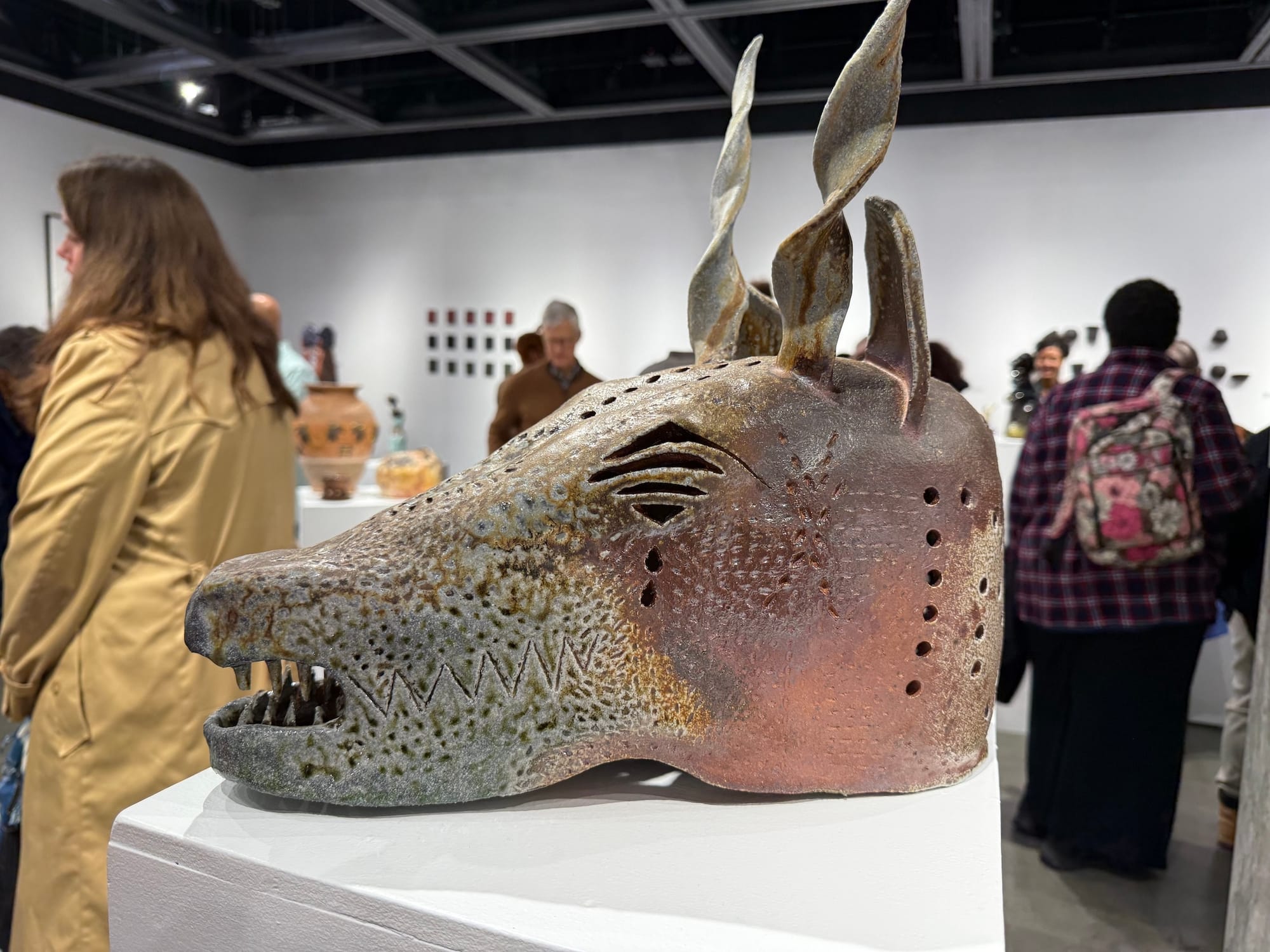
The beast (“Guide #2”) is one of three deliciously unnerving creatures presented by Seattle artist Sierra Bundy, who calls these “protectors.” I’m duly convinced that the bird-like “Shadow Worker” — emerging from a dark mass with a strong beak, twisted horns and snake tongue — won’t allow any evildoers to pass.
Along the back wall, the blue cones are part of the larger series Always & Forever (forever, ever), by Austin-based ceramic sculptor Tammie Rubin, who explores “the power of objects as signifiers… and mythic relics.” While the shapes suggest an immediate connotation with Ku Klux Klan hoods, Rubin says the works also reference “head-dresses and helmets that manifest power, awe, anonymity, horror and magical thinking.”
And there’s much more to see here: Shirley Jackson’s porcelain-style “Br’er Rabbit Totem,” twisted as if stuck in tar; Bianca MacPherson’s mysterious “At Your Leisure (for Lillie, in the Grove),” an alien-like basket overflowing with fruit. When I attended the Black Clay opening in December, it was packed with people making their careful way among the art objects. Visit now and you’ll have more room to take a closer look and a deeper think.
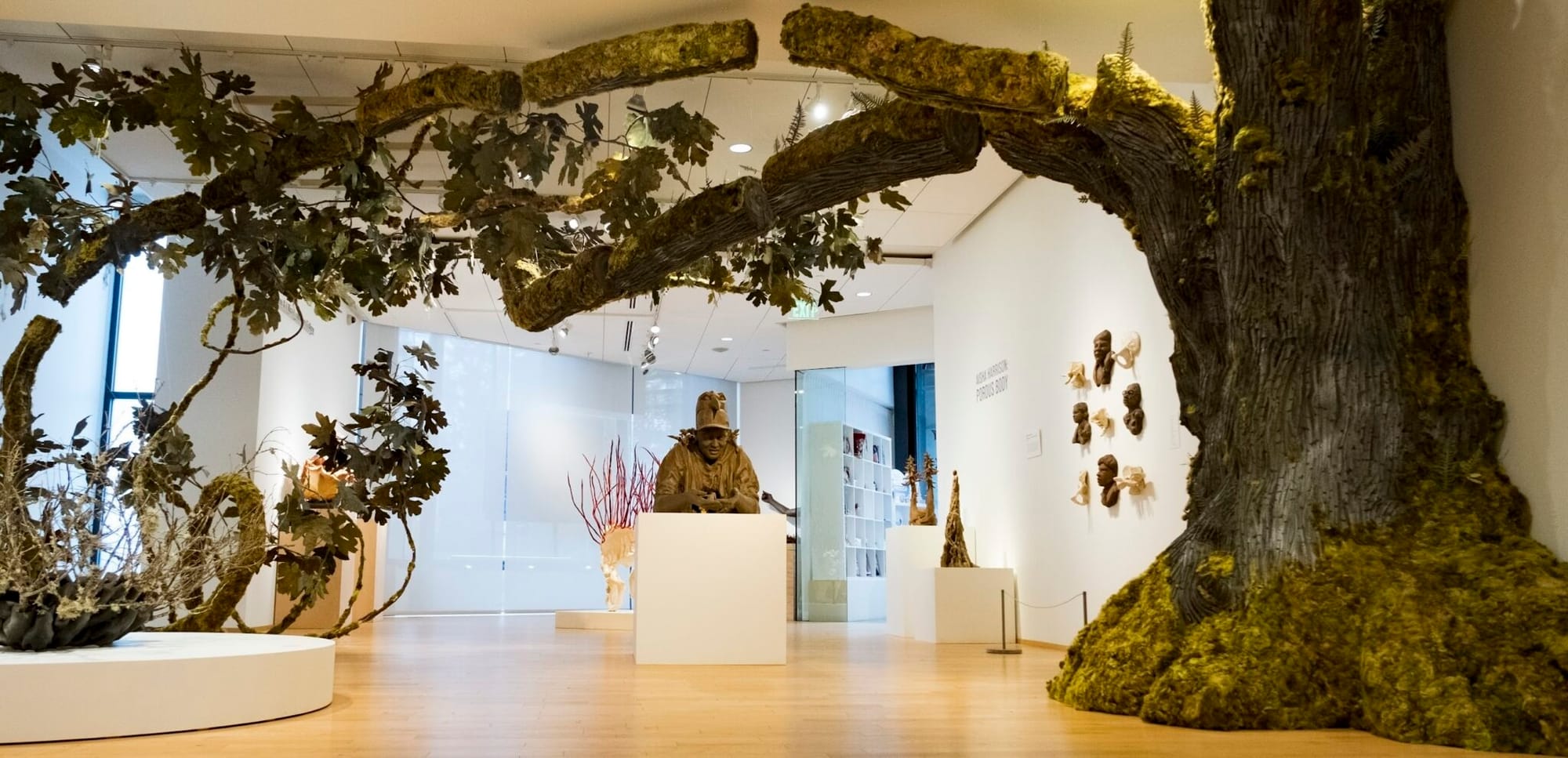
We’re lucky to have even more takes on “Black clay” around town this month. That includes the Bainbridge Island Museum of Art, where Olympia-based ceramic artist Aisha Harrison has a big, beautiful show called Porous Body (through Feb. 22).
In this collection, human and nature merge, often surrealistically: women whose braids become tree roots; a basket woven of hands and branches; a figure whose breath holds a river and wild animals. All these large sculptural bodies await under a huge and lifelike Big Leaf Maple sculpture that Harrison hand-built with help from friends and family.
“This is my body, my ancient memory, meeting up with some kind of spiritual place,” Harrison says of the show. “In that process, I feel connected to everything — plants, animals…. I want to be in this space of in-between, I want to live under the dappled sunlight of the maple.”
At AMcE Creative Arts on Capitol Hill, the group show Sacred (through Mar. 15) includes a large wall installation by another Black ceramic artist, Io Palmer. Based in Pullman and featured in Season 2 of our show Art by Northwest, Palmer creates colorful “thickets” of abstract clay bundles made from tiny individual forms seen in nature.
In her new piece “The Cut Through,” petals and sea shapes in pinks and yellows cluster with orange plexiglass and long blue stems. “The installations are about honoring unseen paths, tangled growth,” Palmer said in an interview with me last year. “They trace the winding, wild and often uncomfortable journeys of people of color and offer a space that honors the arrival, the joy and the recognition.”
If all this Black clay sounds well-timed with Black History Month, you’re right. And if you’re seeking more ways to acknowledge and appreciate the legacy of Black American artists, here are a few more events to consider:
< ArtsWest in West Seattle presents Topdog/Underdog (Feb. 5 - Mar. 1), the 2002 Pulitzer Prize-winner by esteemed playwright Suzan-Lori Parks. The darkly funny tale of two brothers is directed by Seattle theater vet Valerie Curtis-Newton.
< The Paramount welcomes The Wiz (Feb. 10-15 at The Paramount), a newly touring version of the 50-year-old Tony winner featuring Dorothy and her crew easin’ on down the road.
< In Bellingham, at the Whatcom Museum’s Lightcatcher Building, is the new traveling exhibit Personal to Political: Celebrating the African American Artists of Paulson Fontaine Press (Feb. 6 - Jun 28), featuring work by 17 Black artists including Martin Puryear, Kerry James Marshall and the Gee’s Bend quilters.
< And MOPOP has three ongoing exhibits chronicling influential Black music: Never Turn Back: Echoes of African American Music; Wild Blue Angel: Hendrix Abroad 1966-1970; and Beats + Rhymes: A Collective Narrative of Hip-Hop.
Much of Seattle is football-crazed right now, in anticipation of the Seahawks’ command performance at the Super Bowl (Feb. 8). Even arts organizations are jumping on the bird-wagon. To wit: Pacific Northwest Ballet has posted a video of dancers demonstrating graceful ways to throw and catch a football (some impressive, others funny). Seattle Art Museum’s take is the punny directive “go see hawks,” featuring bird art that represents an admittedly loose interpretation of a hawk. I’m always rooting for a good arts-sports crossover, so I love these.
If your pregame is heading to Pioneer Square for tonight’s First Thursday Art Walk (Feb. 5) you’ll have plenty to see, including the debut of Gallery No. 85. Housed in the former Davidson Galleries space at 85 Yesler Avenue, the new venture will focus on contemporary fine art prints (and is staffed by longtime Davidson employees).
Local collective Forest For the Trees is hosting six exhibits in multiple spaces across the Railspur building and Hometeam, including dozens of contemporary artists, live music and live painting. At J. Rinehart Gallery, check out Northwest artist Maggie Jiang’s The Absence that Keeps Shape (through Feb. 25), a collection of boldly graphic paintings based loosely on Tangram puzzles and their interlocking geometry. I have a not-great memory of failing multiple Tangram assignments in elementary school, so I’m hoping this show can be a route to healing.
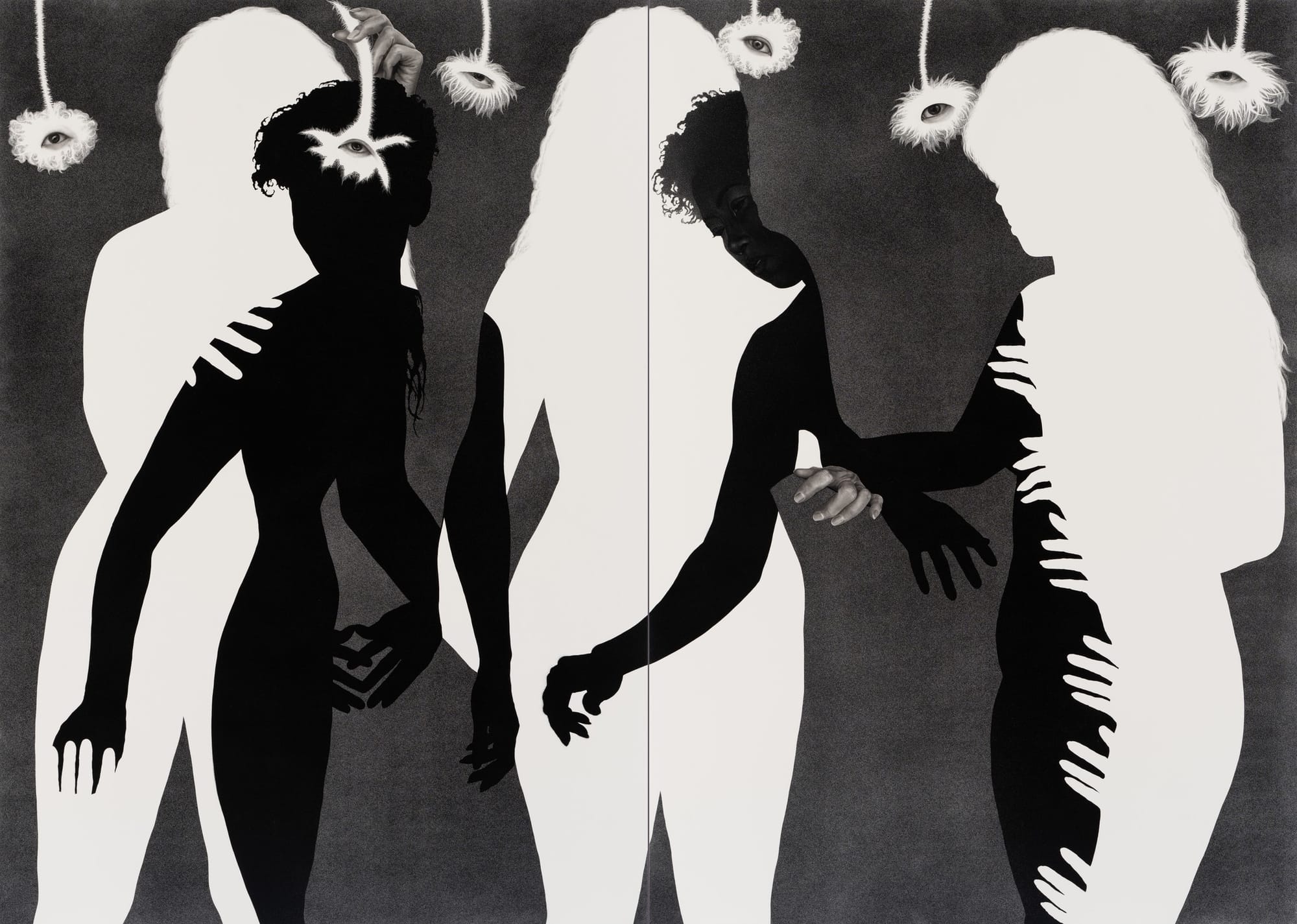
I’m also eager to see the new show by Betty Bowen Award winner Samantha Yun Wall. What We Leave Behind (at Seattle Art Museum through Oct. 4; free opening tonight with artist discussion at 6:30 p.m.) features the Seoul-born, Portland-based artist’s signature shadowy ink and conté crayon works that explore the layered complexities of loss, mixed-race identity and Korean folk tales.
And finally, Go Hawks!
Check out Season 2 of our tv show Art by Northwest, featuring in-depth interviews with the printmakers, painters, sculptors, carvers and photographers who are creating captivating work across Washington state.
